Running out of road

We camped the first night at the Kommer in Loon op Zand in the Netherlands. There was an excellent restaurant and bar just a short walk away, where we drank Belgian Leffe beer in the warm evening sun and watched some very serious wannabe golfers play on a crazy-golf putting course. These folk, mostly couples, carried special briefcases containing golf balls and who knows what else. We saw these little putting courses in several campsites along our route – must be a Continental thing.

Our second night was spent at a pleasant campsite near Hamburg, where we were beguiled slightly at check-in by the promise of a restaurant and a bar on site. As it turned out, the restaurant was adjacent to the campsite, not part of it, and was closed that night! Ever-resourceful, we shopped at the Co Op across the road and dined like kings by our tent on chicken wings, salad, beer and chocolate for a relative pittance.

The ride north through Denmark was flat and pretty dull, but we had a three-night break from camping while enjoying two-day stopover with old friends in the Jutland area. By the time we resumed our journey towards the northern Danish port of Hirtshals, my knee pain had vanished, and Peter had found a neat way of adding occasional back support by holding her fists against the small of my back for 15 or 20 minutes; that helped a lot.
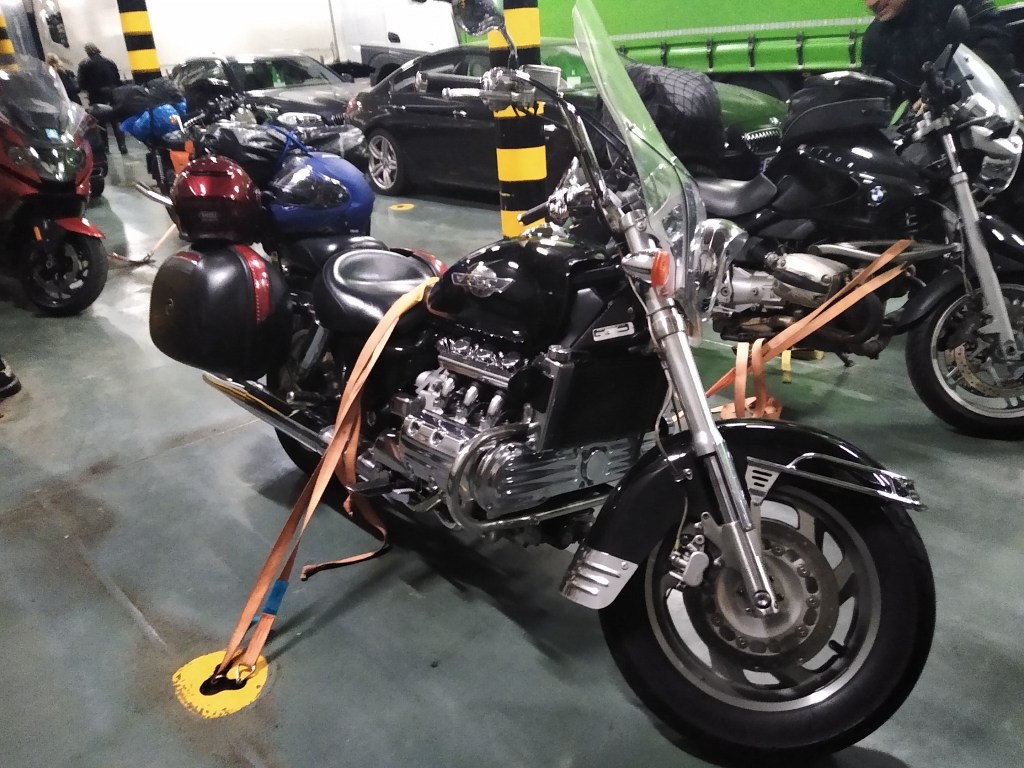
The three-hour ferry crossing to Kristiansand via Color Line was smooth, easy and not bad value at £152. Finally, by mid-afternoon, we were in Norway. We’d taken the precaution of booking ourselves into a campsite for the first night, and duly pitched our new Tempest Pro tent close to a beach on a fjord in record time. The wind was strong and getting stronger, and we thought it prudent to check the weather forecast. The wind would continue, it said, to be joined by rain in the night and throughout the next day. Time for a re-think.

I don’t like riding in the rain. I’ve had to do it for most of my life, especially in the early years when a motorcycle was my only form of transport. Rain, snow, ice, whatever. But I don’t find it fun. Camping in the rain is no fun, either, in my book. Many, perhaps most, of the campsites we were to visit also offered small wooden cabins where you could sleep sheltered from the elements. They typically cost three times then price of a basic tent pitch and didn’t seem such great value, so we never tried them. Instead, we found ourselves a decent hotel 30 minutes away in Kvinesdal, booked ourselves in for two nights, packed up all our gear and abandoned the campsite. The Utsikten Hotel gave us warmth, shelter, a view of the fjord, comfort and food for the next 24 hours until the weather picked up and we could be on our way again. It also introduced us to the £22 hamburger and £11 glass of wine, but hey, this was Norway…

The ever-helpful folk on the Valkyrie Riders Cruiser Club UK group on Facebook had suggested we make contact with the VRCC Norway guys, and a helpful member named Tommy Oppegaard had produced five routes for us that he said together constituted the ultimate Norwegian motorcycle trip. He also offered three routes to get us back as quickly as possible from the Lofoten Islands to Gothenburg, to maximise our time up there. Our hotel lay close to the first route, which took us from Kvaviksanden to Lysebotn. This was what we’d been waiting for!

The smooth road out of Kvinesdal meandered along the edge of the fjord, offering wonderful vistas at every turn. That first morning of the holiday proper was made even more memorable by the lack of traffic – we came across no more than eight cars in the first couple of hours. The weather was warm and dry as we climbed up what became a seemingly endless series of hairpin bends. They were, if anything, more challenging than anything we’ve encountered in the Jura, Alps, Dolomites or Rockies. I thanked my lucky stars for the brand-new Bridgestone Exedra tyres that made rapid bend-swinging such a delight, and the new brake pads front and rear that helped slow us down. This was exhilarating stuff, with many of the corners needing first gear and huge handlebar input to keep the whole ensemble on track.
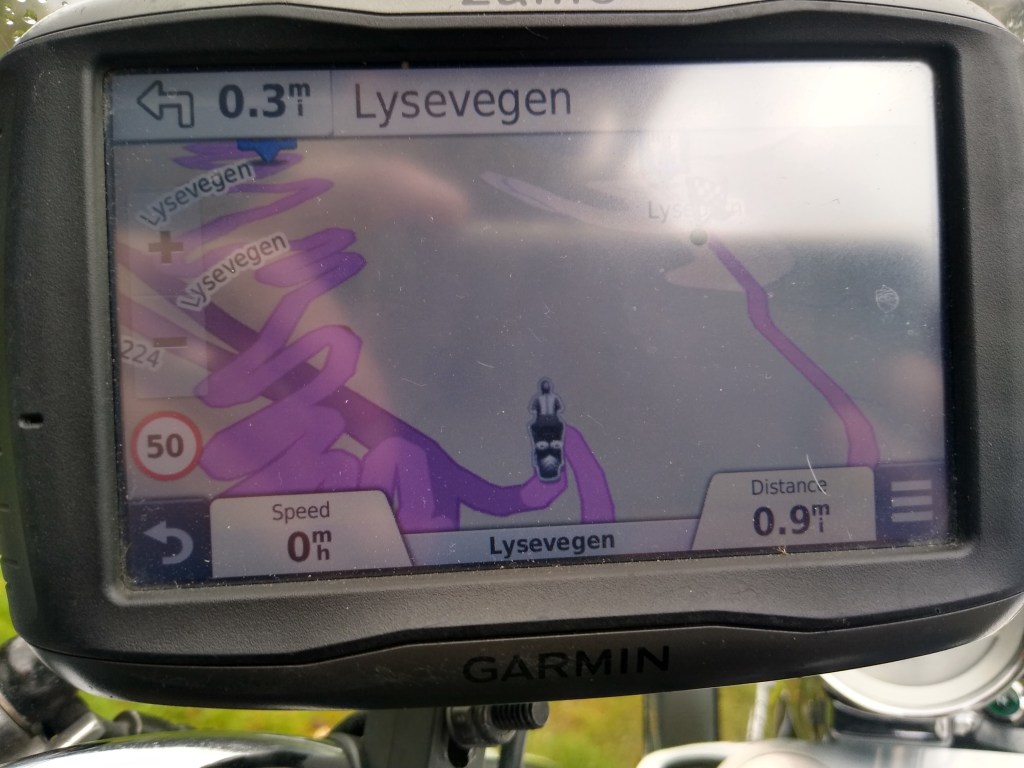
As we rose higher, it grew colder and started to drizzle, which soon turned to rain. For the first time, I felt pleased that I was wearing the Rukka gear and several layers underneath. I stopped to swap my summer gloves for my waterproof winter ones, again pleased I’d packed them. Peter was wearing her trusty Halverssons trousers and Scott waterproof over-jacket and was sitting pretty. Then we entered the clouds, and visibility became a real issue. That’s when we encountered our first mobile roadblock of camper vans, tip-toeing their way around the same bends, often at a snail’s pace.

The road started to descend toward the fjord, lost in cloud way below, and at one point the German camper van in front of us came to a halt when faced with an equally large camper coming up the other way. Neither van (small truck was closer to the truth) could move forward, so they both started to reverse. Now, the Valkyrie ain’t all that good at being reversed at the best of times but pointing downhill with a pillion and 60-odd pounds of luggage on board there is nowhere to go but forwards, so I nipped through a gap to the left of one van and the right of the other and left them to sort it out between them. They must have done, because when we came back up an hour later they were gone.

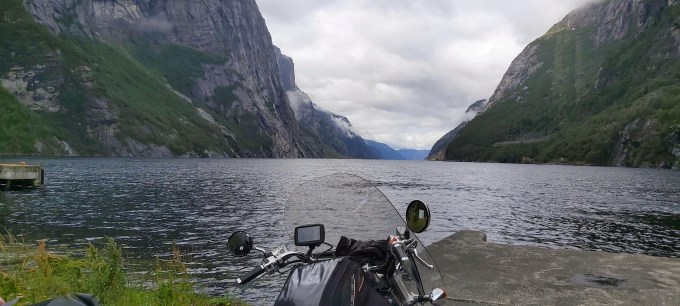
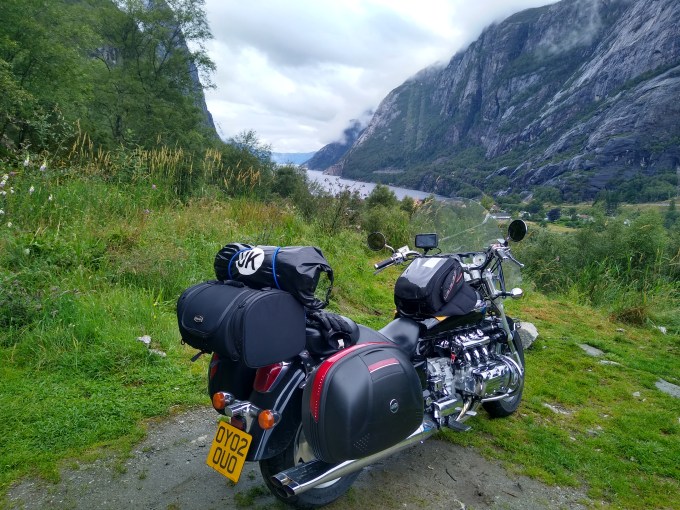
Came back up? Yes, that was a bit of a surprise, because when we finally got down to sea level at Lysebotn it became clear that the road ended right there, at the edge of the fjord (see title photo). We were both fairly taxed by the descent, with its blind hairpins and occasional camper vans. Peter said to me over the intercom: “We don’t have to go back up, do we?” I replied: “No, no. From here we go on to Dalen Hotel.” However, to my total surprise, there were only two ways out: by ferry to somewhere we didn’t want to go, or back up the mountain! So back up the mountain we went, laying the bike over hard, tugging on the bars, and praying we wouldn’t meet something large on one of the bends.

At lunch, back on level territory, we considered the route for the next few days. Tommy had undoubtedly picked out some wonderful roads, but our goal was the Lofoten Islands, and they were still 2,000 kilometres of riding to the north. We decided to cannibalise the route a little, incorporating some of the original roads but taking some shortcuts that brought us to a nice campsite at Røldal and onward the next day to Trondheim.
Norway: the ultimate biking country?

Norway is a fabulous place to ride a motorcycle. I was 55 years into my motorcycling life before I found this out for myself, so, if you’re into smooth, challenging, twisty motorcycle journeys, then you owe it to yourself to go to Norway soon. It lived up to or exceeded all our expectations, including the fact that it’s crazily expensive. We just didn’t expect the weather in August to be so unpredictable.

Getting there from the UK is easier said than done. There used to be a ferry from Newcastle to Kristiansand, but that closed in 2006; and there was a ferry from Newcastle to Stavanger and Bergen, but that ceased in 2008. You could once take a ferry from Harwich to Esbjerg in Denmark, cutting out vast swathes of boring roads, but that too closed in 2014.

These days the only way to get from Britain to Norway on two wheels or four is to make the hard slog across very flat and, to be honest, dull bits of France, Belgium, the Netherlands, Germany and Denmark – or you can cut out a chunk of that by taking a ferry from Hull to Rotterdam. That would have been good for my wife Peter and me, living just two hours west of Hull, but we opted for the Channel Tunnel because it gave us greater freedom to change dates depending on when Peter’s Schengen visa came through (to apply for a Schengen visa, you first need to have firm travel bookings).

There was last-minute scope for a re-think when chaos descended on the port of Dover and the Eurotunnel terminal in Folkestone a week before our departure. News reports of massive traffic jams and delays of up to 21 hours due to (apparently) a shortage of French border officials had me searching for a Hull-Rotterdam booking, but by then all the ferries were full. Our one concession was to change our mid-afternoon Tunnel booking for an early morning one, because the queues got worse as the day progressed. As it happened, the traffic at the Felixstowe terminal was only a little worse than we’d experienced in previous years, adding about an hour to proceedings, but we arrived early and got to Calais at more or less the intended time.

This was our first serious two-up trip with full luggage on the Valkyrie in three years, and the first since the completion of my two years of (happily successful) cancer treatment. Peter reckoned that I’d lost a bit of muscle mass in the process, which I had to concede was possibly true. I’d also been getting unrelated lower back pain over the same period, so the question was how my body would cope with a fully laden bike. It wasn’t so bad on the first day’s ride from Manchester to Kent; maybe this would work out. On day two, across the tedium of that part of France and Belgium, the back pain was more pronounced but survivable. Unfortunately, my helmet was doing my head in – literally. The Shoei Neotec 2 was supplied with a small sponge insert to cushion my skull against the hard ribs that live behind the main liner, and the sponge had shifted, but this was easily remedied. What else would intrude to spoil the ride?

We stopped off in Ghent because Peter reckoned it was worth seeing. Certainly, the old city centre was attractive, but getting out of it was a bit of a traffic nightmare due to roadworks and diversions. That was a mere foretaste of what was to come next day in Hamburg, which is undergoing a truly massive autobahn construction project. The ultra-narrow lanes meant that the Valkyrie with its Givi panniers was too wide to split between the cars, so instead I resigned myself to an hour or so of stop-start progress, sometimes reaching the dizzy heights of 5 mph. It was sunny and hot, and the limitations of motorcycle weight and the wrong riding gear became obvious very quickly.

The back pain of the previous day was getting worse and had now been joined by a sharp pain in my left kneecap whenever I put my left foot down, and a whole new set of pains in my right wrist, bicep and shoulder. The weather was hot, and my Rukka winter riding gear just added to the general discomfort. I found the weight of the luggage, albeit with only the lightest stuff like sleeping bags up high, was creating a sort of pendulum effect at very low speed, making the roadworks section tedious, difficult and painful. For the first time, I really did wonder whether my aging body would manage to get us all the way to the Arctic Circle and back. That afternoon, the jury was definitely out.

Local bike shop gets me out of a bind

The Valkyrie was stuck. It wouldn’t move. The front discs were locked solid. The advice online was to hit the calipers with a mallet to free them up, which worked fine until I squeezed the lever again and we were back to square one.

My first reaction was to get a professional mechanic to sort it out: I’d never worked on brakes before, and it’s not the sort of job you want to get wrong. The only bike mechanic close by couldn’t look at it for three weeks, so I did what every self-respecting individual would do these days: I resorted to Google and YouTube. There was nothing specific on fixing Valkyrie brakes, but I found something for a similar Honda and set about the task.

The right-hand caliper came off with a bit of encouragement, and I duly followed instructions. I squeezed the brake lever to get the twin pistons out. One moved, one didn’t. The advice was to block the one that was moving with a piece of wood and get the other one out, which worked like a charm. The piston was covered in crud, so I cleaned that up, took out the two seals, cleaned out the lands (the grooves in which they sit), inserted new seals and reinserted the now-gleaming piston. This home mechanic stuff is easy!

My video instructor told me to block the clean piston and extract the remaining dirty one. Hah! The brake ever came back to the handlebar and pushed nothing out. Air in the brake lines, I guessed. More online research told me I needed to use compressed air to force the piston out, and that’s not something my humble garage possesses. I was about to head off on holiday and didn’t need the bike till I got back, so I took a break and on my return it was back to the professional, cap in hand: “Help!”

Steve of S&G Motorcycles in Middlewich is an accomplished bike mechanic. He asked me to bring him the calipers, and it took him just two hours to get the pistons out in his workshop, clean them up, insert new seals and then re-install the calipers on the Valkyrie in the comfort of my garage. I’d bought new disc pads, too, for the surprisingly affordable cost of about £21 a pair from Hunts, the Honda main dealer in Manchester.

You know all those warning/advice labels that come on bikes? Yeah, well I never bother reading them either. I’ve owned three Valkyries over a combined period of 15 years, and each one has an engraved message right there on top of the shiny aluminium front brake master cylinder lid: “Use only DOT 4.0 brake fluid.” I’ve seen it so many times but never registered the information, so I’d been to Halfords and bought 500 ml of DOT 5.1 brake fluid (the only one they seemed to stock, as it happens) in readiness for getting the bike back on the road. Steve, fortunately, knew better and had brought some DOT 4.0 fluid with him, so I watched with considerable interest as he bled the brakes back to normal operation. Again, not a job I’d done before. It was such a joy to get the bike back on the road, just in the nick of time for a planned trip to Ireland the next day.

The weather, which had been balmy by late March standards the previous week, had taken a turn for the worse and was promising -1C the following morning. Having seen how easy it is to find yourself sliding on black ice on Manchester’s motorway network, I didn’t much fancy a pre-dawn trip across North Wales at below-zero temperatures to catch the ferry, so with great reluctance the bike had to stay in the garage and instead we flew to Ireland for a few days. The hassle with post-Covid airport security delays, a miserable Irish car-rental agency and an unbelievable grubby and inhospitable Dublin airport made me resolve that in future we go by bike or not at all. The stuff that non-bikers have to put up with!

Still, the Valkyrie celebrates its 20th birthday this year with a mere 30,000 miles on the clock and will, all things being equal, take us on at least one European camping trip this summer. Can’t wait!

Buff envelopes deliver the right to ride – at last!

In this age of instant communication, the concept of excitement when a letter drops on to the doormat must be alien to many. I still get excited, though, sad old man that I am. And the envelopes that excite me the most are those buff, A5-ish ones with the little plastic address window and the words Driver and Vehicle Licensing Agency in the top left corner.

The strange attraction started when my driving licence was withdrawn for medical reasons a couple of years ago – as a precautionary measure. “You must stop driving from today,” the doctor said, so I did. The condition that led to this – a tiny tumour that appeared on a scan in a place where it shouldn’t be – was successfully eliminated within four weeks, but it was many months before the wheels of Covid-era bureaucracy reached the stage where my application to get my licence back was being actively reviewed.

I resorted to calling the DVLA in Swansea for updates. I called a couple of times a week, then several times, and finally every day. This may seem obsessive, but my doctor had sorted the problem the previous September and had confirmed the same to the authorities in March. There was no real reason why I couldn’t drive, or ride, apart from the need for that piece of plastic from Swansea. It was July, the sun was shining, and I wanted to ride. I spoke to several very pleasant and helpful Welsh people over the weeks. On one occasion, a gentle-voiced Welshman, clearly looking at my case on his screen, said: “Ah, Mr Rae, I see you spoke to us yesterday. What can we do for you today?”

During all these weeks I would check the post each day in case, just maybe, the licence had dropped into the box. Then, one day, a nice gentleman at the DVLA answered my call and said he had good news – the licence had just been approved! Yay! Hallelujah! I was free to drive from that moment onward, he told me, and the plastic licence duly arrived a few days later.

If you’ve followed the saga of the shipping of my Ducati and Rune from South Africa to the UK, you’ll be aware that this hadn’t exactly been plain sailing, either. Documents I’d supplied to register them here had subsequently been returned along with a request for more information in each case. So when I picked up the post last Friday and found another bulky, buff, A5-ish envelope from the DVLA, I was pretty sure it heralded more problems. The familiar paperwork inside seemed only to confirm this. Then I read the covering letter – and they’d approved the application for the Ducati! It was officially registered, and with the same plate it’d had when I first registered it in Reading back in 2008. The letter said that the V5C registration certificate would follow separately “in the next four weeks”. It actually arrived the next day.

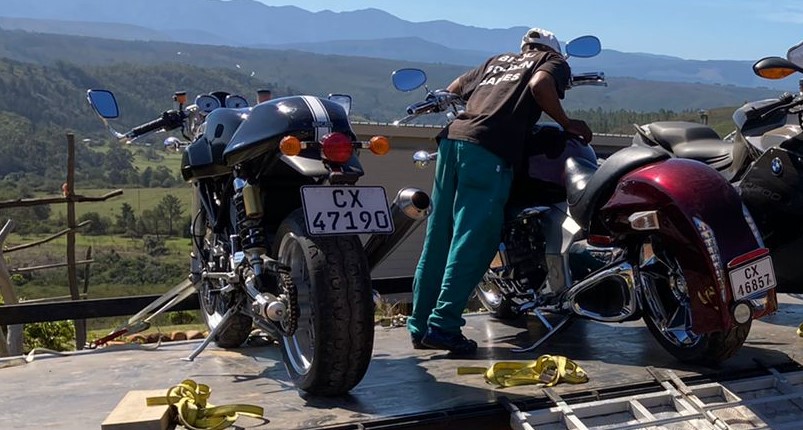
So now, fully six months and one week after the Sport Classic and the Honda Rune were loaded on to a truck in Plettenberg Bay at the start of their long journey, at least the Ducati was legal to ride once again on public roads. Of course, it’s been raining for days now and the forecast suggest more of the same.

Today, however, three weeks on, has dawned bright and sunny. It’s cold but the sky is blue and the roads are dry so I fire up the Ducati and head down the M6 to Stoke to pick up an oil filter from the Ducati dealer. The Termignoni racing exhaust is making sweet music and it feels so good to be back in this particular saddle. It may be only 7 degrees C outside but its 21 degrees in my heart and 31 in my soul as I take in the autumn colours and get in sync with that unique Ducati vibe.

As I pull back on to my driveway 90 minutes later, the postman walks towards me with two buff, A5-ish envelopes bearing the DVLA logo in the top left-hand corner. The first one I open turns out to be confirmation that the Rune has been registered, finally. Oh joy! The second contains the new registration document. A Ducati ride and a road-legal Rune – all my Christmases have come at once, almost seven months to the day after the bikes started their journey. Then I try to move my faithful Valkyrie in the garage and find the front brake is seized and the bike is immobile. Into every life a little rain must fall…

At last – all road-legal in the UK, seven months on. This isn’t the UK, obviously, but Knysna Lagoon in the Western Cape.

Bogged down in a paperwork jungle

They say that anticipation is the greater part of pleasure. I’ve already written about my long-drawn-out anticipation of the arrival of the Ducati and the Rune in the UK. Would the reality live up to the dream?

I’ve owned the Sport Classic since I bought it new in January 2008, and the Rune since January 2016, so it’s not like we’re strangers. I’ve just spent a small fortune shipping them more than 8,000 miles – so of course they were going to be great to ride again. Even the all-too-short trip to the MOT centre, and the slightly longer trip back again, was an ample reminder of why I like these two very different bikes so much.

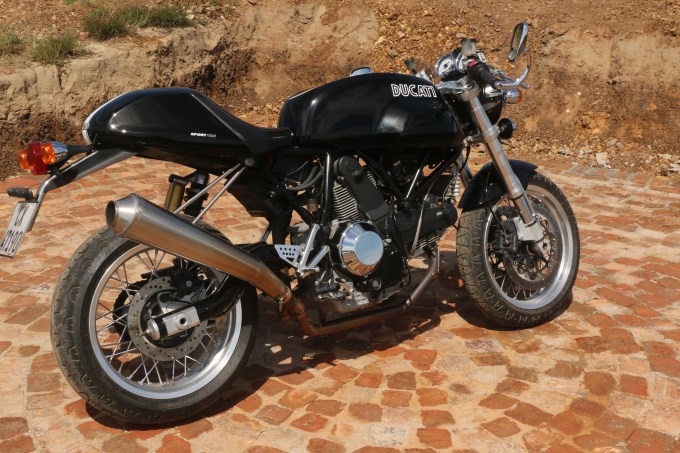
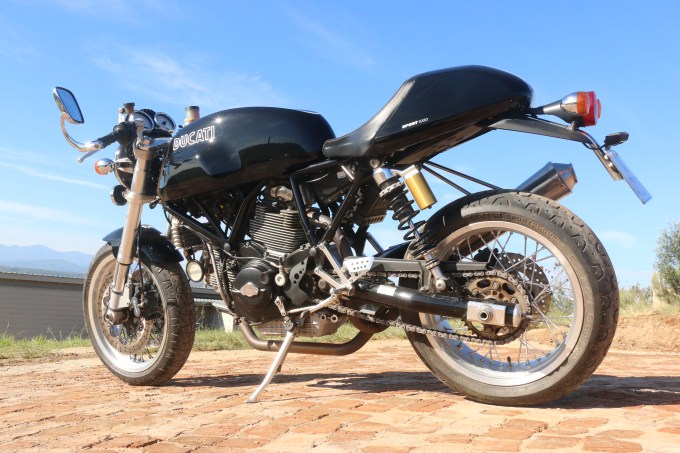
The Ducati for me always held the promise of my old 1974 GT750. It was, after all, designed specifically to be a 21st century version of that bike’s 750 Sport sibling, but with all the (many) glitches ironed out. It weighs only 181 kg and puts out about 95 bhp with its Termignoni racing exhaust system. It’s a basic bike – a great engine, two wheels, a seat, a tank and that’s pretty much it – and I see it rather as a latter-day Vincent. It gathers speed in what feels like a very traditional way, giving a visceral push towards the horizon without the exponential feel of a modern four. You either like the glorious feel of a sporty V-twin, or you don’t, and this bike does it for me. I plan to add new Pirelli Phantoms when I get the cambelts replaced soon and it’ll be ready to carve its way through the twisties once more.

Parenthetically, I think it’s nuts in this day and age to design an engine that needs new cambelts every two years, regardless of mileage, at a cost of almost £300 a time including labour and VAT. My old 1997 Suzuki TL1000S, still residing in South Africa in readiness for our next visit, was designed as a Ducati 916-slayer in its day, and it’s never needed that kind of expensive maintenance.

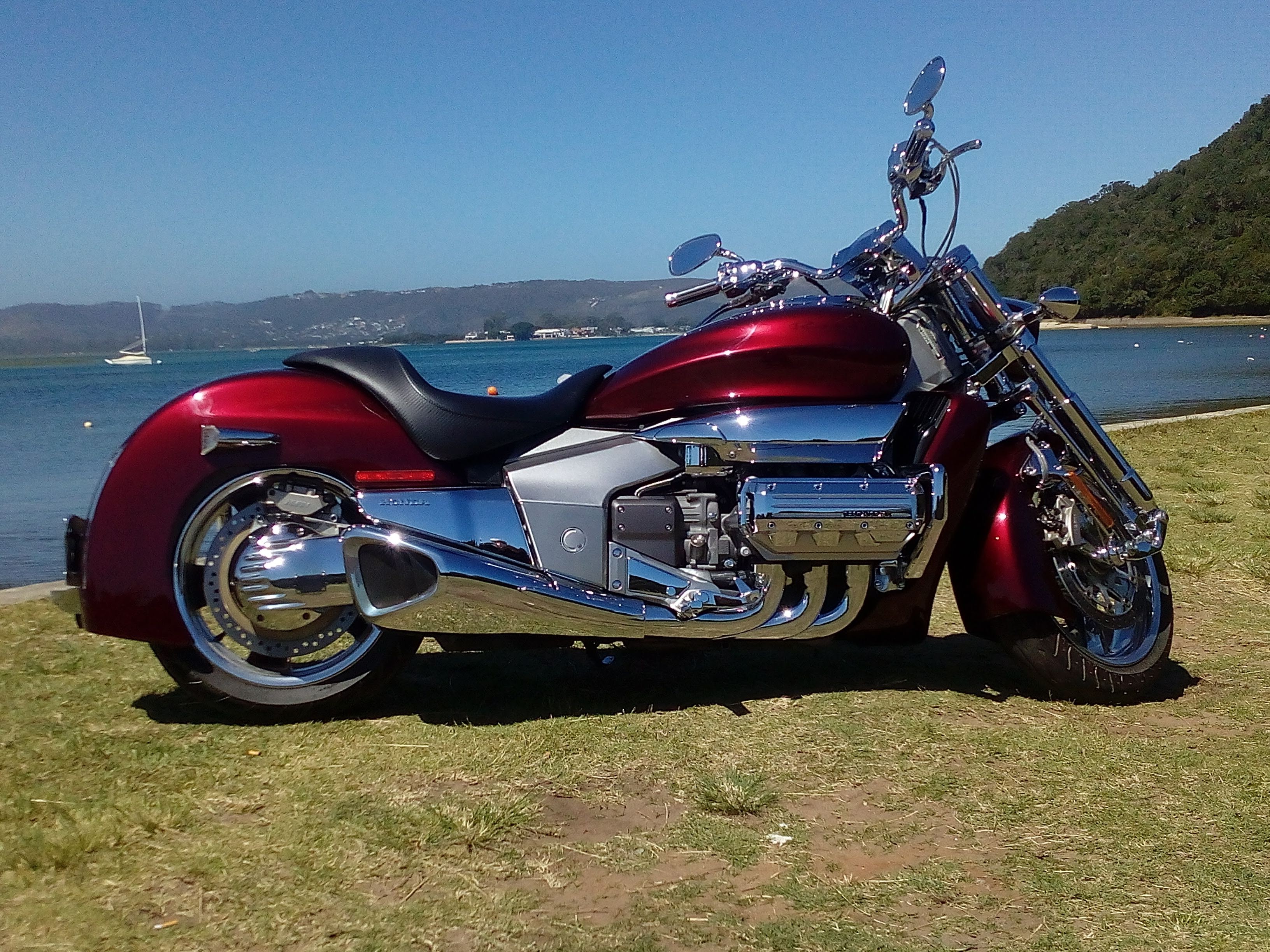
The Rune couldn’t be more different. Take the unburstable (and low-maintenance, by contrast) 1800 Gold Wing engine, tweak it a little, and dress it in one of the funkiest outfits ever to grace a production motorcycle, and you have a unique bike. It weighs 368 kg dry, 398 kg wet, and is fully eight feet long. It has presence. I was reminded of its considerable heft when I had to manoeuvre it into our newly prepared garage, which is approached by a short and slightly downward sloping driveway. Riding it in nose-first was not an option: no way was I ever going to reverse it out again. The trick is to ride it down the drive, turn hard right on to our neighbour’s drive, and perform a four-point turn to reverse it the last few metres into the garage. It takes all the strength in my shoulders and legs to keep the beast upright in those manoeuvres.

Out on the road, it’s wheeled emollient (a phrase I borrow with due credit from Car magazine’s description of the V12 Jaguar Series III XJ6 back in the late ‘80s, and eminently appropriate for both vehicles). The exhaust emits a pleasant burble that becomes a growl on acceleration but never gets raucous. The engine is about as smooth as they come. It develops 118 horsepower at 5500 rpm and 167 Nm of torque at 4000 rpm (or 123 ft lb in old money). That’s enough to move the machine down the road with impressive urgency, with a 12-second standing quarter time, made all the more satisfying by the total absence of vibration. It’s said to be capable of 123 mph or so, but the riding position means it hits a real sweet spot at about 60. That means you can chill out, savour the moment, and overtake pretty much any normal traffic with a flick of the wrist, all safe in the knowledge that you’re not likely to fall foul of speed cameras outside built-up areas. Its slightly outrageous appearance turns heads, for sure, but that’s not why I bought it – it just needs to turn my head, and it does that every time.

Sadly, turning my head is all either bike will be doing for a while yet. My attempts to register them as UK bikes have failed so far. Both applications have been rejected by the DVLA. In the case of the Rune, the issue was lack of proof of year of manufacture; with the Ducati, it was the absence of the original certificate of first registration in South Africa.

This Ducati rejection was a bit galling, because I had sent the original UK registration certificate from 2008 with my application. The same bike had merely travelled to Dubai, Abu Dhabi and South Africa before coming home again. However, the DVLA gave me the option of explaining by letter why I didn’t have the certificate of first registration from South Africa (it’s lying in a filing drawer in our house down there, still inaccessible due to Covid travel rules), so I’ve done that and sent everything  back to Swansea. The year of manufacture thing with the Rune was a bit galling too, because the Rune was made only in one year, 2004, although I believe some were made in 2005. If I said it was 2004, that should be good enough, in my book! If it were a 2005 bike, why would I claim it as 2004? The VIN plate on the headstock even proclaims 2004 in large numbers. The DVLA helpfully said they would accept a letter from Honda confirming the year of manufacture. A call to Honda’s UK HQ quickly confirmed that such a letter was indeed possible, for a fee of £30, but it would take up to six weeks. Five weeks later, I’ve just received a note to say the letter is ready and will arrive shortly. Then I can send off all the paperwork to Swansea again. First World problems…

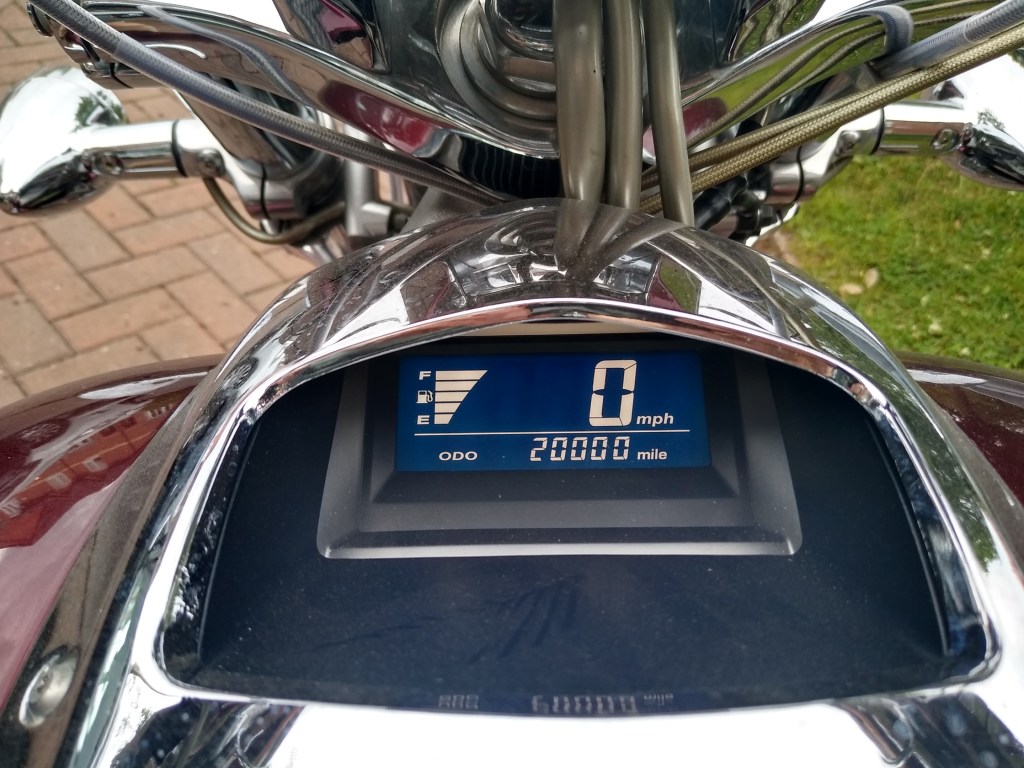
When the Rune arrived on my driveway, straight off the boat, I changed the settings from kilometres to miles and was greeted by this number

Dream bikes arrive – just don’t plan on riding them anytime soon!

I’m 67 years old but I’ve been feeling a bit like a child counting the days to Christmas. For me, the long-awaited presents are my Honda Rune and Ducati Sport Classic, due to arrive in Middlewich after a journey that began 11 weeks ago on the Garden Route of South Africa’s Western Cape.

Regular readers will be aware of the ups and downs of the process, but my concerns over the arrival of the bikes didn’t end when the ship finally docked at London Gateway, the port on the Thames Estuary in Essex. Oh no.

First comes the tracker confirmation that the ship has actually berthed alongside the quay. Yay! I wait patiently for about 24 hours to give the shipper time to get the cargo off. The ship sets sail again about 10 hours later. The shipper confirms that the container is off the ship and that the bikes have been cleared through Customs. Double yay!

I’m thinking, ports are super-efficient, and the constant throughput of containers means they can’t have my bikes laying around there for long, so they’ll probably be on the road tomorrow – or, worst case, the day after. Hah! Not so fast. It seems that someone else’s cargo inside the same container hasn’t yet cleared Customs, so unloading the container has to wait until that has cleared, too. That takes eight days. Then the shipper says they can’t get a haulier to move the bikes the 200-odd miles from Essex to Cheshire until 5 July – which is a further 10 days away!

Look, freight isn’t really my field, although I did a stint in that industry as a PR adviser about 20 years ago, but I would have thought a shipper would know what was coming through and when, and have the requisite vehicles on hand to move the goods onward. A friend tells me there’s a shortage of HGV drivers in the UK right now, so maybe there’s a shortage of large van drivers too – thanks, Amazon, for creaming off the talent!

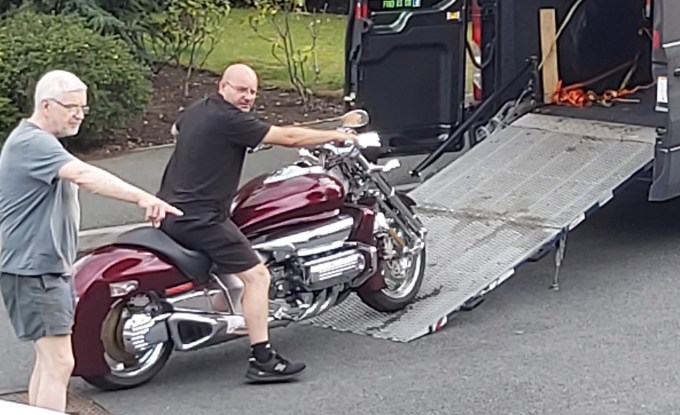
A driver and van is eventually found and booked, and now he’s delivered the bikes to our driveway. He specialises in motorcycle transport, which is a relief, and it takes him no time to unload the machines. I’m delighted, of course – I haven’t even seen these bikes since the start of the Covid lockdown in March 2020, when we had to cut short a trip to South Africa and high-tail it back to Blighty. And I haven’t ridden them since June 2019, due to such diverse factors as my health and the unrideable state of the dirt road to our house down there.

Anyway, here they are. I scrutinise every inch to check for shipping damage. The Ducati looks flawless but the battery is flat, so I connect a charger. The Honda actually fires up at the touch of the button, and the mellifluous sound of the 1,832cc flat six bellows out of those two massive exhaust pipes – awesome! There’s a very small new scratch on the rear mudguard, and the brushed aluminium pivot cover down near the right footrest has scratches that weren’t there before. Apart from these, though, it too looks unaffected by its long journey. Tyre pressure are low all round, but that’s easily put right.

I spend many hours washing and then polishing both bikes. The Ducati is easy, having little in the way of bodywork; the Rune takes the bulk of the time, because the weeks sitting on docks or in the container have made all that chrome look a bit dull – but that’s why God invented Autosol! That Honda gets polished better than I’ve ever cleaned a bike before, hard-to-reach spots and all, and ends up looking truly magnificent. The Autosol tube ends up almost empty.

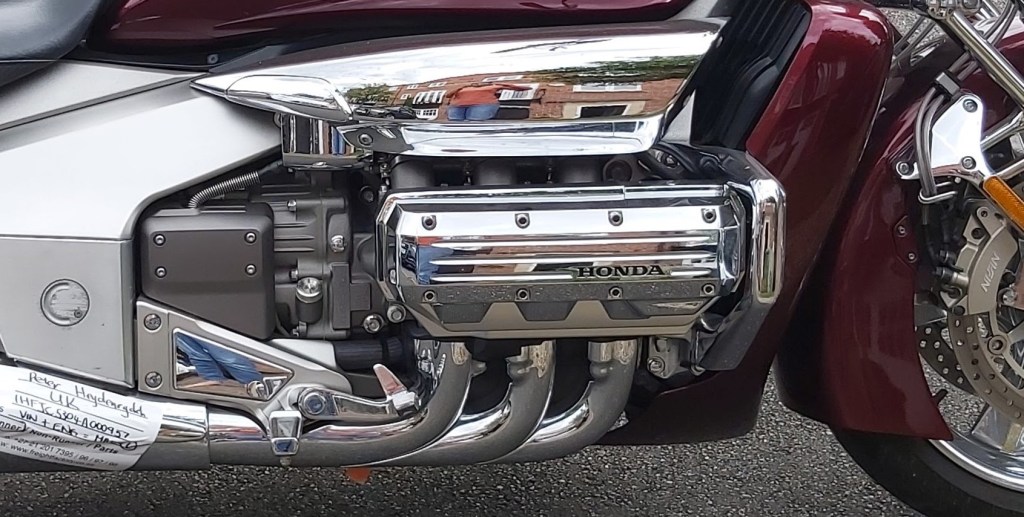
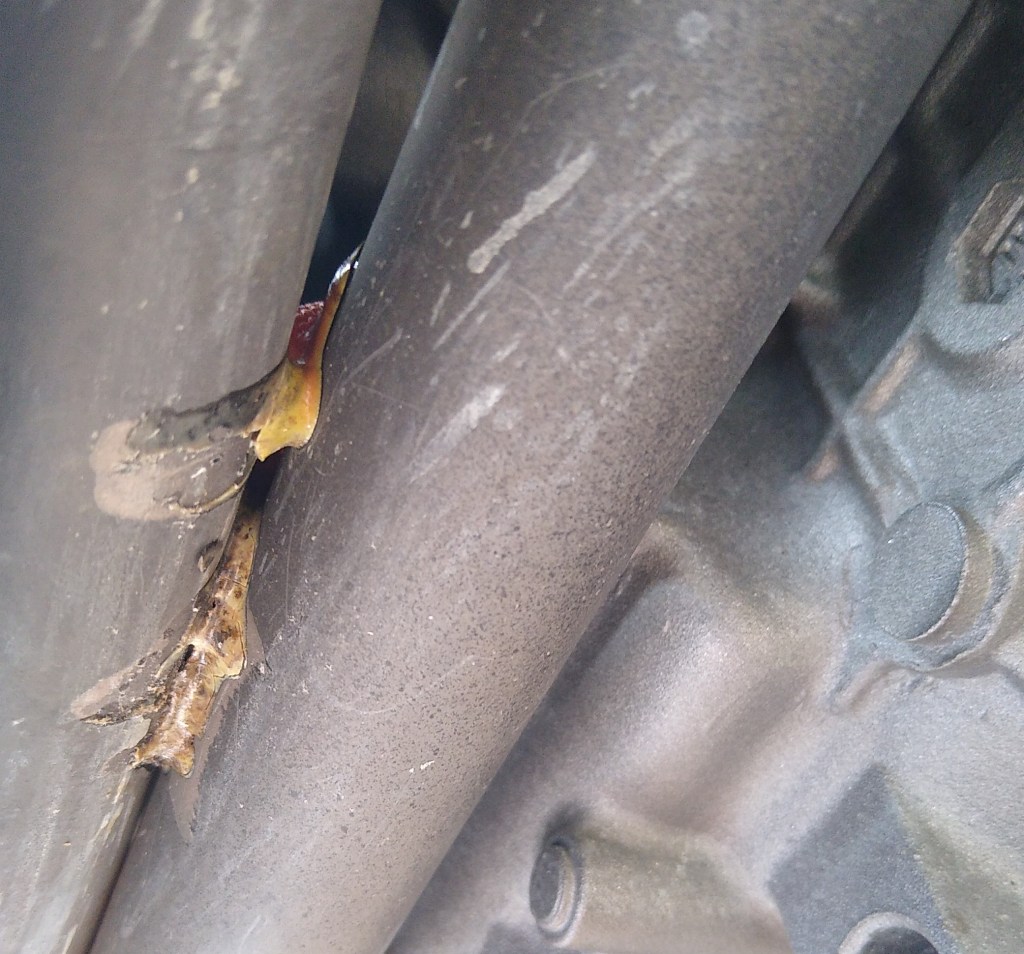
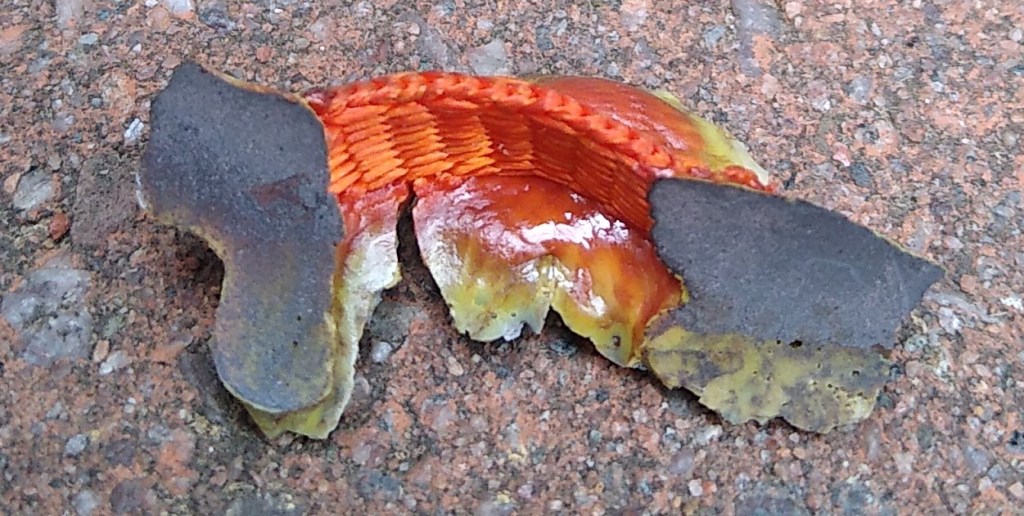
There’s a bizarre-looking piece of bright orange webbed strap hanging between the header pipes on the right-hand side. The only possible explanation for its presence is that it had been used to tie down the bike at some point in its travels, although there’s no logic to its placement. Tying down the bike through that area makes no sense at all. Someone clearly couldn’t get the strap off again and so has cut it with a knife just below the pipes. Closer investigation shows that the material has in fact melted into the headers, and it takes some careful poking and scraping to detach it completely. Fortunately the point of melting is behind the headers, and they’re hidden in turn behind bolt-on chrome covers.

I’ve managed to get the two bikes insured on my Valkyrie policy using just the VIN numbers, thanks to a really helpful agent named Nathan at Carole Nash. However, they would be insured only for a trip to and from a pre-booked MOT test. It’s very tempting and totally legal to book them in for the tests some 50 miles away and enjoy the ride there and back, but the weather forecast is for rain showers and I don’t want to spoil all that gleaming chrome and paintwork, so I wuss out and book them into a great MOT centre, DC Lomas, just two miles from my house. They both pass with flying colours – the tester described them as perfect – and they make it home without catching a speck of dirt or water.

You’d think I could now apply to have them registered, but no. Again, not so fast! I have to wait until Her Majesty’s Revenue & Customs (HMRC) issue a thing called a NOVA certificate for each bike. The bikes were landed and processed on 15 June; the NOVA certificates were issued on 15 July. You wouldn’t want to be in a hurry! Anyhow, with all the paperwork now to hand, I send everything off to the DVLA in Swansea. Not being able to ride the machines again until the DVLA issues their registration numbers is a pain: I’ve already paid in full for their insurance, MOTs, registration fees and 12 months’ road tax. It’s not like anybody is missing out financially, and the MOT engineer says the bikes are in perfect shape. Oh, and we have a mini heatwave… I’ll just have to be good and ride the Valkyrie!

Anticipation is everything

As I write, my cherished Honda Rune and Ducati Sport Classic are just over six hours away from arriving on British soil. Maybe. I know they left Cape Town on 31 May, about five days late and on a different ship. But I know from a helpful note from my shipper that they were due to arrive on MSC Argos at London Gateway port at 01:45 – two days ago.

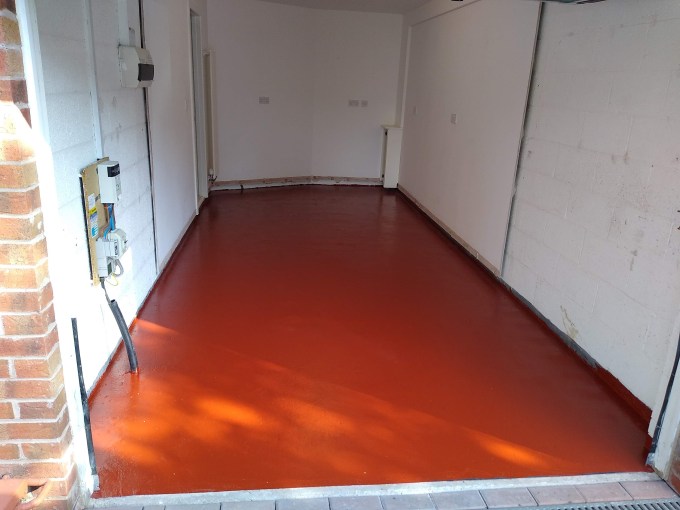
An update last week from the UK shipping agent told me they were now due to arrive yesterday and would be transported by road to our house in Stockport (near Manchester). No! Wait! Did I not tell the South African shipper weeks ago that I’d be moving to Middlewich? Of course I did. I gave the new address to the UK agent and was assured that the bikes would be brought to my door. As you can see above, the garage is freshly painted, ready and waiting (a story in itself).

I’d been tracking the bikes on their journey, after a fashion. There are tracking apps out there that can pinpoint any ship anywhere on the planet, so I dipped into that world a few times. (This may come as a shock to a certain gentleman’s barber in Middlewich, into whose emporium I stuck my masked face a few days ago. “Do you take walk-ins?” I asked, the haircut being a spur-of-the-moment thing. “No, bookings only,” came the reply from the barber, an aging hipster with a full grey beard. “Can you use an app?” he asked, pointing at a sticker on his door advertising a service called Booksy. I assured him politely that I could, and left. Can I use an app?!!! Cheek! What age did he think I was? I found a friendly Middle Eastern barber shop a bit farther down the street and had an excellent haircut for a tenner, without having to declare my IT prowess. But I digress.)

It seems as though there are indeed services that can track ships in real time if you register and, I imagine, pay. I didn’t fancy the payment bit – this shipping process was already costing enough. One site suggested the MSC Argos was cruising around the Caribbean, which didn’t sound right, somehow. More detailed digging found that there was indeed a sailboat called Argos hanging around the sunkissed islands, but it was not my Argos. Another site told me that my Argos was heading for Las Palmas but was currently off the west coast of South Africa, steaming North at 18.2 knots. Given that it had supposedly left Cape Town a couple of days earlier, it certainly hadn’t got very far. Then I spotted a little note saying that data may be up to five days old.

Not being a total luddite (aging hipsters take note), I looked up London Gateway’s website and found a detailed schedule of all arrivals and departures. And there, on the list, was my ship! It was due to dock on the morning of 15 June at 02:00 from Rotterdam – a day later than the agent had most recently suggested, but close enough. Almost time to pop the champagne cork. A subsequent check yesterday told of a further delay; it was now not arriving till 14:45. Sounded like they’d missed the tide, or something technical like that. Thought I’d see whether Rotterdam has a similar schedule and, naturally, it does. This morning it shows 101 ships in residence and 168 recently departed. Bizarrely, the MSC Argos is not on either list. Hmmm.

When I worked in Hong Kong back in 2000, I had a client called LINE that specialised in optimising global cargo transport. I know from those happy days that container ships don’t alter their schedules or ports of call on a whim. It’s a hugely precise business. LINE even had software to optimise loading, telling crane operators where to plonk (a technical term) each container to ensure its ready accessibility for speedy removal at its destination. Clever stuff. So, knowing that businesses all over the UK and Europe are awaiting eagerly their just-in-time deliveries of rooibos tea, biltong, Stellenbosch wines and BMW 3-Series parts, I shall assume that the good ship Argos will indeed be berthing at London Gateway at 14:45 this afternoon. Then it’s a simple matter of the shipping agent processing the paperwork with HM Customs, a forklift driver loading the bikes very carefully on to a truck, and the Rune and Ducati should be here sometime tomorrow-ish. Oh, the joy of anticipation!

Sweet six carb fix delivers ride with a mile-wide smile

It’s only 3 degrees out there but I’ve just finished a ride with a smile a mile wide. After 13 months of enforced layover, my Valkyrie had sounded out of sorts when I fired it up for the first time. Ran on three cylinders for a bit, then the other three joined in, but it was rough, especially below 2,000 rpm. Something was amiss – and the mile-wide smile is the result of some clever input from a guy called Andy: the Valk now runs like a dream.

My first reaction to the problem was to take the machine out on to a fast stretch of road for a 20-mile blast to blow the cobwebs away. It helped, but not much. My next recourse was to ask advice from the Valkyrie Riders Cruiser Club UK group on Facebook; as ever, members were quick to respond.

The most likely explanation was a build-up of ethanol at the bottom of the tank that had gummed-up some of the jets in the six carburettors. A couple of people recommended a product called Sea Foam, but it would take five days to arrive and I wanted the bike sorted faster and more cheaply than that. Another recommended using 98 octane fuel, which I tried (hard to find, even if you settle for 97); the engine seemed to run better on that, but it wasn’t perfect, didn’t provide a fix, and cost a fortune! A browse through Halford’s presented a few different products offering to clean your carbs, including good old STP; I had no idea it still existed, having proudly put an STP sticker on my helmet 50 years ago. The STP seemed to help, but the bike was still running a bit rough below 2,000 rpm.

The solution came by chance. Son-in-law Nikolas donated a folding bicycle to our son James. It needed both brake cables renewing, so I found a guy called Jason who sorted it all out at a reasonable price. He had a Suzuki 600 Bandit under a cover in his workshop, so we got talking bikes. He mentioned that a mate, Andy, who was an expert with carbs, had re-jetted the bike to suit the aftermarket pipes and it ran like a dream.

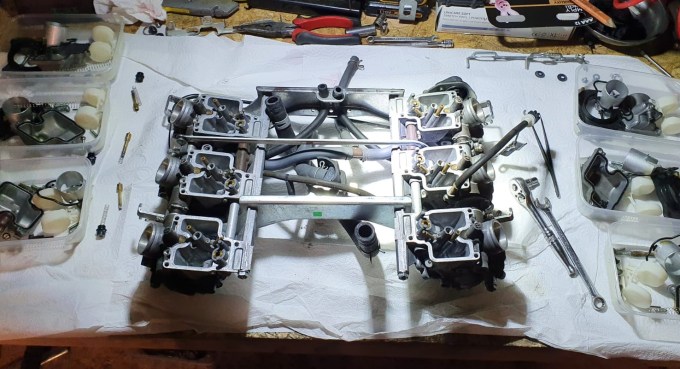
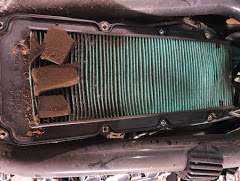
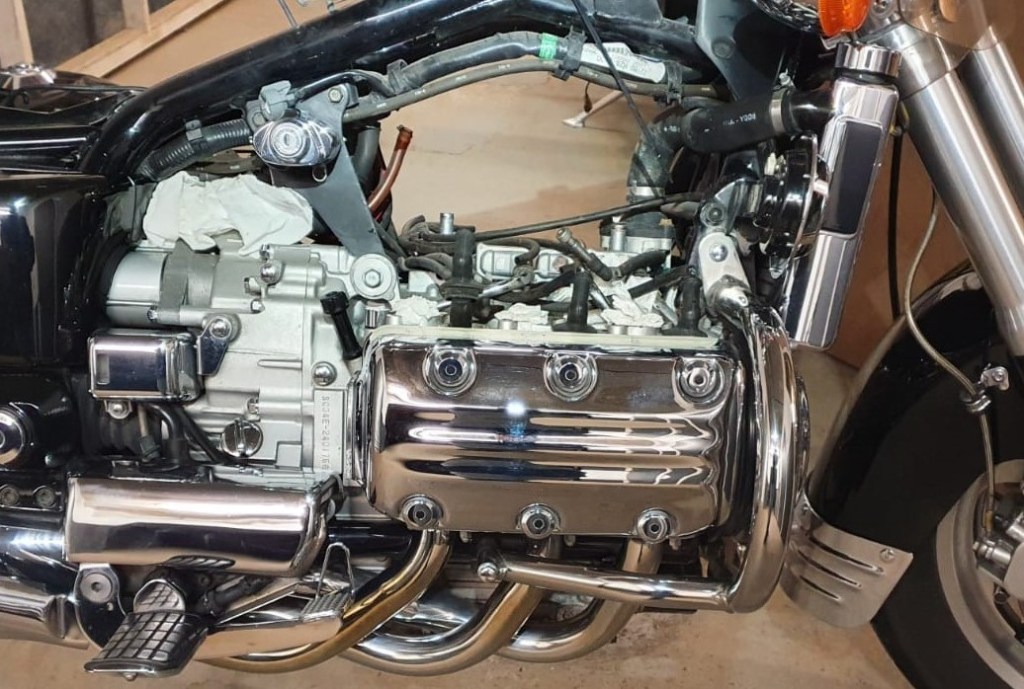
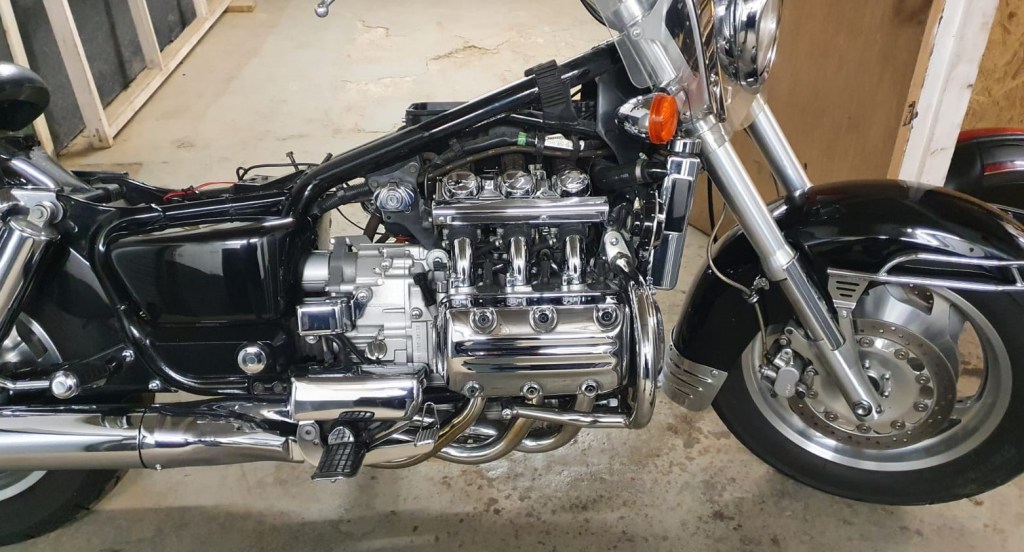
Andy turned out to be a qualified motorcycle mechanic who had never worked on a Valkyrie but was happy to strip, clean and rebuild the six carbs for me. You can see his neat, well-ordered approach in the lead photo. As soon as he had the tank off, he found an incredibly dirty air filter that could have been the main problem all on its own. That in itself was a surprise, because in the seven years I’ve owned the bike I’ve always had it serviced by Honda main dealers to maintain its unbroken full service history since it was new in 2002. I’d have expected the dealers concerned to have replaced the air filter whenever required; I’ll have to check through old paperwork to see whether they did.

The Valkyrie also has a pre-filter, a sponge-like thing that now lay in near-total disintegration over the air filter. Maybe that was causing the poor low-speed running? Or maybe it was the two split vacuum pipes, or the fact that some of the airbox rubbers connecting the carbs were coming away from the airbox? If this were a detective novel, there were already several credible suspects before he’d even got to the jets.

Andy fully stripped the carbs but found no unusual deposits – said he’d seen many worse examples. In any event, he soaked them in carb cleaner overnight and put them back together. He replaced the vacuum tubes and the pipe to the carb heaters, and re-sealed the airbox rubbers. He installed the new air filter (great service from Fowlers, by the way – ordered 18:35 Tuesday, delivered 08:55 Thursday) and made up a new pre-filter from Scotchbrite, which was another helpful tip from the VRCCUK folks on Facebook.

I knew the moment I fired it up that it was much better. Once warmed-up, it was a revelation: the original smooth, sweet-revving flat six was back. No roughness below 2,000 rpm, or anywhere else for that matter – just creamy power. Result! I have no idea which of the various maladies caused the problem, but there is no doubt some combination was responsible. It’s just great to have my old bike back. Now if only the weather would run so sweetly…

Back on the road to utter joy

It was a Friday in late summer, but it was like all my Christmases had come at once. Right up there behind my wedding, the birth of my children and riding my first CBX. That Friday was the day I got my driving licence back after a year’s break – not for doing anything naughty, I hasten to add, but on doctor’s orders.

It started with a scan that showed my melanoma (a more serious form of skin cancer) had spread internally to a few parts of my body in the form of small “nodes”. One of them showed up in my brain, sadly, and the doctor said no more driving or riding from that moment on. It was just a precaution, in case I had a seizure or something, which happily I never did.

In practical terms, it was no big deal. My wonderful wife became my chauffeur overnight, and getting from A to B was never a problem. But if your main hobby has been riding motorcycles and driving cars, losing your licence is quite a blow. Having independent transport has been part of everyday life since my 16th birthday 50 years ago, and I’ve taken it for granted.

The only important thing was that the doctors zapped the offending node a few weeks later with a targeted 30-minute dose of radiation, and got rid of it completely. A few months later, the even better news was that my course of immunotherapy had got rid of all the cancer, which was an occasion for great joy. But this is not a tale of cancer: it’s a tale of getting a driving licence back after it’s been taken away.

It’s not as easy as you might imagine. The doctor had the power to say “don’t drive”, and that was that: 10 seconds of conversation. Getting back on the road ain’t so easy. It’s not up to the doctor but to the DVLA (for any overseas readers, that’s the UK’s driver licensing agency). My doctor wrote to the DVLA on 19 March this year telling them that in his opinion I was fine to drive again – in time for spring. Yay! Unfortunately, the Covid-19 lockdown happened four days later. It would take five months, two questionnaires and umpteen phone calls to get my licence back. That Friday a few weeks ago I called yet again, and a lovely Welsh accent told me: “I have good news for you, Mr Rae.” Those are the sweetest eight words I’ve heard in a long time. Result!

It was raining, of course, while most of the intervening months had been dry and sunny, and the Valkyrie was way too clean to get dirty. So I got to drive our car for the first time since we’d bought it a year ago, and decided it was jolly nice. By Saturday the roads had dried out and I took the bike to the nearest garage to put air in the tyres and fill the tank. It was like meeting an old friend after a long absence.

It wasn’t all plain sailing. The engine sounded and felt a bit rough, like it was starved of fuel, but the ever-helpful folk on the Valkyrie Riders Cruiser Club group on Facebook suggested several fuel-system-cleaning remedies. One was horribly expensive and would take days to arrive, one was cheaper but would still take days to arrive, so I bought my first-ever bottle of STP (remember STP?) and that improved the carburetion. Still a bit sub-par, but pretty good.

It was all quite a schlep, the licence thing. I don’t question for a moment the need for a doctor to be able to take people off the road in an instant if they pose or might pose a risk to others. But I do question why it should take five and a half months in total for the same doctor’s judgement that it’s safe to drive again to be put into effect. Even a pandemic like Covid-19 shouldn’t mean that the DVLA effectively shuts up shop for three months or more and deals only with “key workers”.

Anyway, the bike is taxed and insured, I’m licensed once more, and days of open road and endless sunshine beckon. Maybe.