V-Strom on the road again at half the price

Sometimes the easiest solution to a motorcycle repair problem – as with much in life – is simply to spend the money and get it sorted. So it proved with the long-running saga of my Suzuki V-Strom and its broken magneto rotor.

Having had no success whatsoever with trying to source a secondhand rotor, I bowed to the inevitable and decided to buy a new one. The man who’d offered me a secondhand rotor for R5,000 had claimed that a  new one would cost about R14,000. I called my nearest Suzuki dealer, which was in Mossel Bay, about 140km from our home in Plettenberg Bay. Yes, they could get me a new rotor: it would cost R9,155 (about £390), which was a pleasant surprise, and it would be there within three days. The repair shop I spoke to a year ago said it would take three weeks! I bought it over the phone and collected it a few days later. The V-Strom’s future was looking more positive.

The next hurdle was removing the remnants of the old rotor. Online research had showed that this needed a blow torch and a compressed-air-driven impact driver. Late last year, a motorcycling friend in Plett named Stan had introduced me to one of his friends who had all the tools I’d need. A quick call to Stan now revealed the very sad news that his friend had since died rather suddenly. Stan suggested I try a local Plett repair shop called Muddy Offroads, which said they’d be happy to help.

They duly collected the bike in their bakkie, removed the old rotor, installed the new one, installed a new oil filter, filled the sump, and it was ready the next day. The only problem was the battery, which was only a few weeks old when the magneto failed a year ago but had clearly not enjoyed being on trickle charge for the past year. That would take an extra day. The whole job involved three hours’ work which cost about £65, plus £47 for the battery and £42 for the oil. Okay, the oil seemed a bit pricey but everything else was a bargain. They’d even cleaned and lubed the chain, so the  logical thing to do on picking the bike up was to take the slightly longer way home, via some empty local roads with a few twisties thrown in. The total cost of repairs, including the new rotor, was half what the other bike shop quoted me last year.

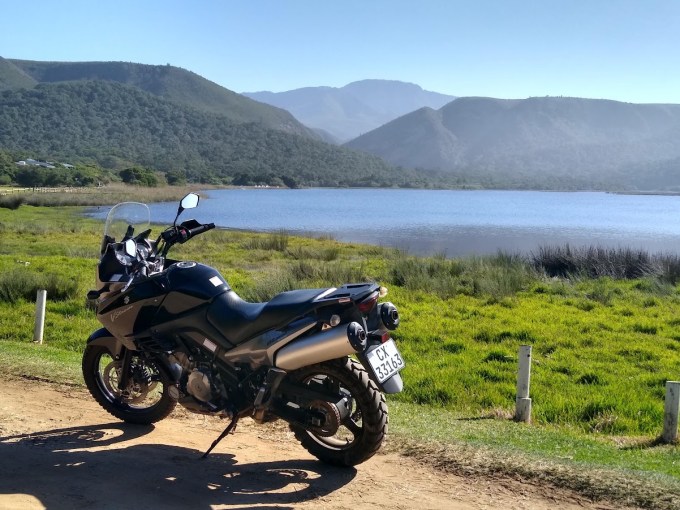
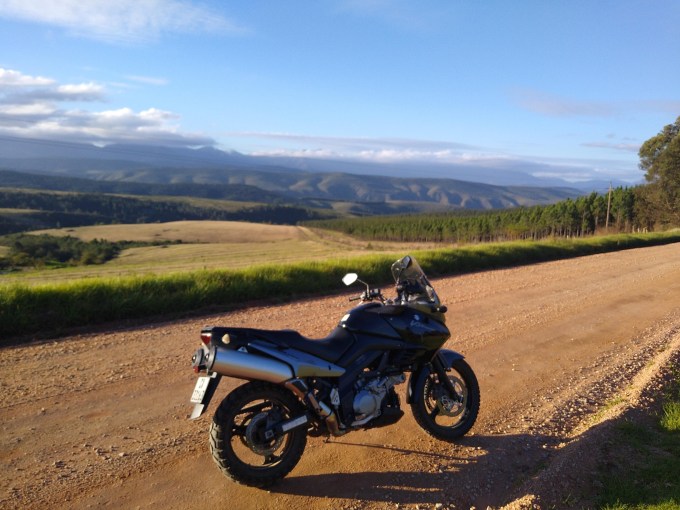
It felt wonderful to be on the V-Strom again after its 14 months of enforced idleness. It really is a fabulous bike and truly put a big grin on my face. I’ve ridden all my other bikes in that time – the Ducati and the Valkyrie (both since sold), the Rune, Gold Wing, TL1000S, Triumph Tiger XC800 and Yamaha TW200 farm bike – and they are all great at what they bring to the party, but the V-Strom has its own unique, relaxing cadence.

The grin was still there yesterday when I rode it out to Sedgefield and Karatara in 23-degree sunshine (that’s what passes for mid-winter in these parts). The bike was still its comfortable, sure-footed self. It fulfils the same role as the Tiger 800, and has only 21,000km on the clock from new, so we’ll probably need to sell one or the other. For now, though, the V-Strom is going to get a lot of use. It’s been worth the wait.
The curious case of the missing magneto rotor

Did you ever buy a motorcycle part, pay for it, and then find it’s been delivered to some unknown person 890 miles away? Me neither – until now!

Having left my ailing Suzuki V-Strom in my garage in Plettenberg Bay for the duration of the European summer and the South African winter, I turned my attention to finding a second-hand magneto rotor in the British parts market. Should be easy, I figured. Hah! There weren’t any. A new one would set me back all of £670, or R15,000, compared with the R8,970 I‘d been quoted in South Africa. So no solutions in the UK, then.

Now back in South Africa to escape the British winter, my wife and I decided we’d sort out the V-Strom ourselves. The local repair shop had told me back in May that they’d found fragments of metal in the oil and that therefore they’d need to strip the engine completely and rebuild it, at a total cost of R22,000, which is now about £950, which was both expensive and, I thought, perhaps a bit unnecessary.

My first move was to drain the engine oil, and out poured the cleanest, clearest oil I’ve ever drained. Not a fragment of metal or anything else foreign in there. The oil filter was equally pristine. Even the small magnet in the drain plug was free of swarf. On that basis, I figured there’d be no fragments of magnets elsewhere, so set about stripping off the magneto cover. That showed the stator windings to be undamaged, which boded well – and there was no sign of any magnets, whole or in bits, anywhere! The mechanic at the repair shop had clearly taken them out and not put them back when he replaced the cover and trailered the bike back to me, at my request, unrepaired. If they were all broken or damaged, fair enough, though it would have been nice to tell me.

Mt wife’s ex-husband (a total Suzuki fan whose GSXR 1000 weighs only 166kg) recommended a used parts emporium in Cape Town, which didn’t do used parts anymore but recommended another parts dealer, which did. The price was a firm R5,000 (about £220), which seemed a tad high for a second-hand part but not extortionate, given the paucity of rotors. Shipping to my nearest depot in town was R110 (a mere £4.80).

The dealer was good enough to warn me that extracting the old rotor required ideally a blow torch and a compressed-air-driven impact driver. Not having such exotic equipment, I phoned a friend who has a friend who has everything I’d need – including a trailer with which to transport the bike to his workshop. What a result!

I waited the quoted three business days for the rotor to arrive. There was no sign of it. I asked for a tracking number. The dealer said he’d had trouble getting the rotor off the donor bike due to load-shedding, a peculiar South African practice whereby whole segments of the country are denied electricity to conserve supplies. It’s been going on for ever. Anyway, it was a plausible explanation, so I went with it. Chased the guy again a day or two later, and now he said his air tool wasn’t working properly – please give him a few more days. I had other bikes to ride, so I said fine.

Almost three weeks after buying the rotor, the guy said the part was now off the bike and on its way to me by express delivery. I called next day to get the tracking number, and that’s when he confessed there’d been a terrible mistake and it had been sent by the courier company to Mpumulanga – a province in the north-east of the country and about 890 miles from where I live! He apologised profusely and volunteered to refund the money. Damn straight! The R5,000 price was duly refunded, but not the R110 for the courier. The guy said he’d get the part back and send it again. I decided not to hold my breath.

I thought I’d chase it up again today, not expecting any progress. The guy was again most apologetic, saying that several branches of his nationwide parts business had been seized by gangsters who were trying to extort money from him to get the branches back. You’re thinking, nah! Didn’t happen.

But you know, it could actually be true. I know a guy who went out with a friend to buy a car trailer advertised in the press. They drove to the address they were given, only to be seized by seven armed gangsters who shoved them in the boot of their own car, drove them to a warehouse and roughed them up a bit, then used their cards to steal money from their bank accounts. They released them after about seven hours, dumping them by the roadside. They walked to the first house they came across where the clearly very poor occupants gave them food and a place to sit until someone came to fetch them.

That absolutely true story has an interesting ending – two interesting endings, in fact. My friend went to the police station to report the abduction and theft of money, cards, bank funds and car. He told the cops that he wanted to thank the people who’d helped him. “How will you do that?” the cop asked. “Give them some money?” My friend answered yes, exactly that. “It would be much better if you could give their son a job,” the cop replied. And now their 22-year-old son has a job as a well-paid intern in my friend’s IT firm. Great result.

Another twist was that a week after the incident, the gang tried the same stunt again – but this time their ad was answered by another gang, who showed up armed to the teeth and shot all seven of them dead!

So, in this beautiful but strange country, it’s entirely possible that my Suzuki magneto rotor supplier was telling the gospel truth. Regardless, I’m on the lookout for another rotor!

The unattractive truth about loose magnets

The news from the motorcycle repair shop wasn’t good. The battery charging issue with the V-Strom, they said, was down to the flywheel, not the regulator, but they couldn’t get their hands on a second-hand example anywhere. A new flywheel would set me back R7,810, plus VAT, plus labour. Oh, and flywheels were back-ordered and delivery would take six to eight weeks.

That wasn’t all: the problem was with the flywheel’s magnets, which had come loose. The mechanic had found shards of broken magnet in the oil, so the recommendation was to strip down the engine completely to ensure that there were no other shards waiting to destroy the engine from within. The total cost of the repair would be around R22,000, which is a shade over £900, which to me is a lot.

The deal-breaker was the six-to-eight-week wait for the part; I had to head back to the UK in three weeks and wouldn’t be back till much later in the year. So I had the bike trailered from the workshop to our home for a very reasonable R450 (about £20) and there it now sits while I consider my options.

I paid about £3,500 for the bike in December 2010, and as a going concern it could be worth around £2,500 in South Africa today. The nearest bike-stripper will give me about £600 for the Suzuki, which ain’t enough, frankly. So the decision now is based on whether I can find a second-hand flywheel in the UK, bring it back in my luggage on our next visit to South Africa and fit it ourselves (my wife and me); check out the price of a new part in the UK and see if it makes sense to buy it there; or go ahead with the South African repair and costings.

It’s primarily a financial decision now, as the propensity of V-Strom 1000s to shed their magnets seems all too high, according to the owners’ forums, and so I have no massive desire to keep the bike. Once again, it seems as if our horribly bumpy dirt road has claimed another victim; it could so easily have played a part in shaking the magnets loose. I’ll do some parts-shopping and reach a decision this summer.

It’s a shame in another sense, too. I’d been thinking about replacing the UK-based Honda Valkyrie with a smaller, lighter bike. I’ve been experiencing an irritating but not debilitating pain in my right arm when riding the Valkyrie over the past year, which I have attributed to the riding position. A few years ago I burst one of my bicep tendons and decided against having it repaired, as the majority of people who went for the repair seemed to be body-builders or serious weight-lifters. For everyday life, you can get by with just one tendon, and I have – until now. I think that the angle of the Valkyrie’s bars, their height, and the need to hold the throttle open manually for long periods have conspired to cause me pain in my wrist, forearm, bicep and shoulder. It sets in within an hour, whereas I can ride my wife’s Tiger 800XC, the V-Strom, the Ducati Sport Classic and the Suzuki TL1000 without any pain.

Okay, that’s not entirely true: the Ducati and the TL are beginning to be a pain in the neck, literally, from the need to keep my head up from their naturally head-down riding position, but that’s another story! But the new Triumph 900 GT Pro seems to have a lot to offer as a tourer, along with the same flat bar as the Tiger 800, and the V-Strom likewise. The reputation of V-Stroms for alternator and regulator issues, however, has eliminated in from the list. I plan to try the Triumph anyway, and probably the Yamaha Tracer 900 and the BMW 1250 RS. They each offer a useful weight saving over the Valkyrie – more than 100kg in the case of the Triumph – which might be welcome as the years advance.

In the meantime, I’m not quite ready to walk away from the wonderful Valkyrie. It’s my third, and I’ve owned one for a total of 18 years. I’ve tried to tackle the problem from the other end – me! Can the arm problem be fixed to the point where the pain goes away and the Honda becomes a pleasure to ride again. I’ve started with six sessions of acupuncture to my arm and neck. The chiropractor reckons he’s found a few issues that he can deal with, and that’s already having a positive effect. A bit of gentle work with weights, gradually increasing the load, might help complete the task. I shall be reunited with the Valkyrie in mid-June and can’t wait to see if the problem’s been sorted. Otherwise, it’s bike-shopping time!