There are few better feelings than riding a motorcycle you love through flowing bends on a warm sunny day. We all know this. For those of us who live or spend a lot of time in the northern hemisphere, it might happen in July or August, if we’re lucky – but definitely not in early February.
You have to have lived in northern Europe to appreciate fully the sheer joy of warm sunshine at a time when experience tells you it should be very cold and probably very wet. I remember in my days as a journalist being flown by Honda to the south of France in December 1978 to test the new CX500. We’d taken off from London Gatwick in snow, yet that same evening we were in T-shirts strolling by the Mediterranean in 21 degrees C. Bliss.
One recollection from that launch was a conversation I had with a young member of the Honda design team responsible for the CX500. This was an era when Japanese bikes in general didn’t handle or stop as well as their European rivals. I had recently sold a Ducati GT750, which handled and stopped particularly well – even if running reliably was a bit of a stretch! I asked the engineer why Honda couldn’t make a bike more like a reliable Ducati, and he grinned widely. He told me he understood completely, because he rode a Ducati to the factory each day, much to the irritation of some of his colleagues because they felt he was being disloyal. “Wait till you ride the CX, and you will see we are making progress,” he told me. He was right about the progress, but it was still no Ducati…
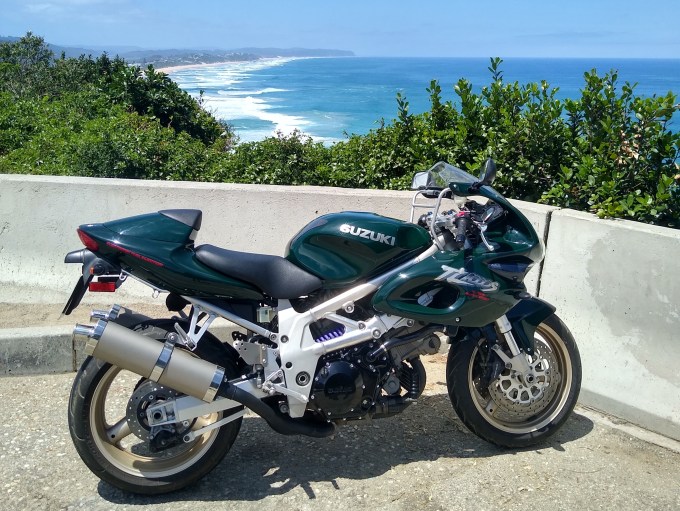
The subject of today’s tale is my trusty 1997 Suzuki TL1000S, which I’ve owned for the past 21 years, back on the road after having its front brake calipers cleaned and new seals installed. The location was South Africa’s Garden Route, about as far south as you can get before hitting Antarctica. It was 29 degrees C under clear blue skies with a gentle breeze and a few small fluffy white clouds as picturesque features.
The roads, relatively busy until a few weeks ago due to the influx of tourists for the Christmas holidays, were almost deserted. In sharp contrast to Britain’s roads these days, they were pothole-free and smooth, which was a welcome bonus.
My wife and I had been busy with a whole bunch of house maintenance and entertaining visitors, among other things, but the bulk of the work was happily behind us and our latest guests had just left. Our dirt road, which is our only access to South Africa’s tarred road network, had been abominable in recent weeks, a mass of corrugations and potholes that threaten to tear rugged vehicles apart. It even destroyed the throttle sensor on our pick-up truck a few weeks earlier, so there was no way the relatively stiffly sprung TL was going to cope. But the grader guy was just here a few days earlier to smooth it all out, creating a window of opportunity to get the Suzuki out of the garage. It was time to ride.
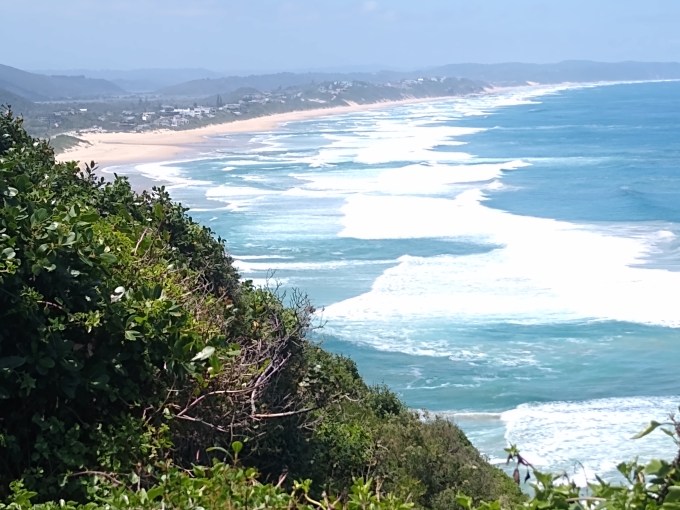
The N2 is the main highway connecting South Africa’s east and west coasts through the southern end of the country. It’s just two lanes for most of its length, but with light traffic that’s not always an issue. I made it to Wilderness in time for a chicken mayo sandwich and Pepsi Max lunch overlooking the beach. Sometimes you get to see schools of dolphins playing in the waves below, but not today. The view, nevertheless, was as spectacular as ever.
Onward to the large regional town of George, and through it to the start of the Outeniqua Pass. This is a beautiful road, blessed with scores of fast, sweeping bends and a few slower ones, climbing steadily from sea level to 800 metres before dropping down into farmland that soon gives way to the desert known as Little Karoo.
Speed limits are quite strictly enforced in South Africa, as much as a revenue-earner as for road safety. The speed cameras used to be grey and almost camouflaged, but in recent years the fixed cameras have been painted bright yellow and are pretty visible. Less visible are the mobile cameras, nasty little grey-green things that the police place meticulously in front of vertical posts and other road furniture to make them almost impossible to detect. The rules state that there has to be a cop stationed and visible within a few hundred metres of the camera, but of course this almost never happens. The good news is that there are no licence points for speeding, just fines, which are typically about 200 rand or £9, so getting caught speeding isn’t a disaster.
This meant that I could concentrate purely on the road ahead as it wound its way upward through the foothills of the Outeniqua mountains. The bends flow easily from one to the next, connected by shortish straights, against a stunning backdrop. It had been a while since I’d stretched the TL, and it was pulling so strongly up the hill that I thought I’d change up to sixth – only to find I’d been in top gear for the past few miles! The bike accelerated so easily from bend to bend, and I’d forgotten the strength of its pulling power. The almost total absence of traffic – one car and one truck the whole way up the pass – added to the sublime pleasure, and I found myself changing down to fifth and even fourth once or twice to enjoy the thrust. But sixth would have sufficed the whole way.
The engine felt smooth and the bike handled as steadily as I always remember it. It’s been out of production for about 24 years and technology has moved on significantly since its heyday, but honestly it offers me so much pleasure I can’t imagine ever replacing it. Yes, the Gold Wing is infinitely better as a tourer, the Rune a unique riding experience, the V-Strom and Tiger adventure bikes more suitable for the local dirt roads, but the TL is the perfect sports bike for me. And mine still has just over 9,000 miles on the clock from new…
I was two weeks away from turning 71, and I think the aging process is responsible for the tingles I get in the fingers of my right hand after an hour or two in the saddle. I suspect some form of damage resulting from a torn bicep tendon 10 years ago, and the TL activates the sensation more than the other bikes. The Valkyrie used to do the same, despite its turbine smoothness, and I suspect it’s a riding position thing: high bars and low bars. The flatter bars on my other machines are less bothersome.
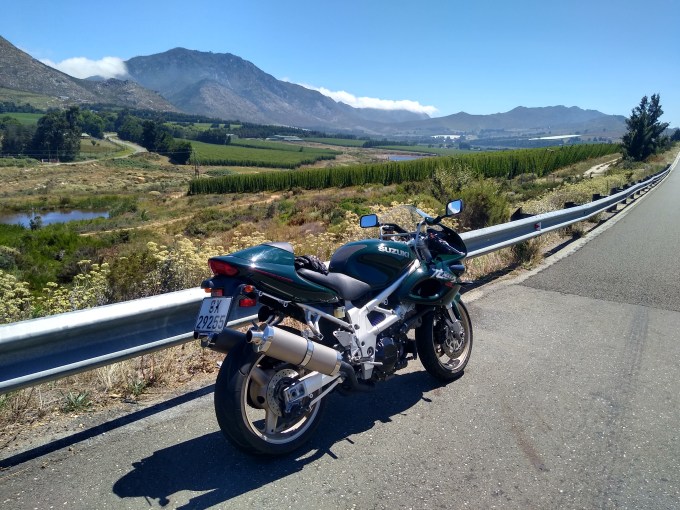
Having reached the farmland below the mountains (photo above), I made a U-turn and relived the twisties back up the pass and down into George before heading for home, having enjoyed the best few hours’ riding I’ve experienced for many a year. As I said, bliss!
 roadriderblog