Anticipation is everything

As I write, my cherished Honda Rune and Ducati Sport Classic are just over six hours away from arriving on British soil. Maybe. I know they left Cape Town on 31 May, about five days late and on a different ship. But I know from a helpful note from my shipper that they were due to arrive on MSC Argos at London Gateway port at 01:45 – two days ago.

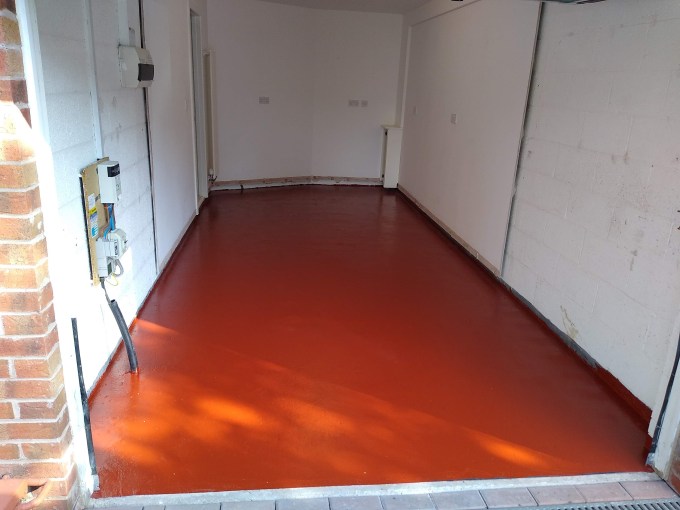
An update last week from the UK shipping agent told me they were now due to arrive yesterday and would be transported by road to our house in Stockport (near Manchester). No! Wait! Did I not tell the South African shipper weeks ago that I’d be moving to Middlewich? Of course I did. I gave the new address to the UK agent and was assured that the bikes would be brought to my door. As you can see above, the garage is freshly painted, ready and waiting (a story in itself).

I’d been tracking the bikes on their journey, after a fashion. There are tracking apps out there that can pinpoint any ship anywhere on the planet, so I dipped into that world a few times. (This may come as a shock to a certain gentleman’s barber in Middlewich, into whose emporium I stuck my masked face a few days ago. “Do you take walk-ins?” I asked, the haircut being a spur-of-the-moment thing. “No, bookings only,” came the reply from the barber, an aging hipster with a full grey beard. “Can you use an app?” he asked, pointing at a sticker on his door advertising a service called Booksy. I assured him politely that I could, and left. Can I use an app?!!! Cheek! What age did he think I was? I found a friendly Middle Eastern barber shop a bit farther down the street and had an excellent haircut for a tenner, without having to declare my IT prowess. But I digress.)

It seems as though there are indeed services that can track ships in real time if you register and, I imagine, pay. I didn’t fancy the payment bit – this shipping process was already costing enough. One site suggested the MSC Argos was cruising around the Caribbean, which didn’t sound right, somehow. More detailed digging found that there was indeed a sailboat called Argos hanging around the sunkissed islands, but it was not my Argos. Another site told me that my Argos was heading for Las Palmas but was currently off the west coast of South Africa, steaming North at 18.2 knots. Given that it had supposedly left Cape Town a couple of days earlier, it certainly hadn’t got very far. Then I spotted a little note saying that data may be up to five days old.

Not being a total luddite (aging hipsters take note), I looked up London Gateway’s website and found a detailed schedule of all arrivals and departures. And there, on the list, was my ship! It was due to dock on the morning of 15 June at 02:00 from Rotterdam – a day later than the agent had most recently suggested, but close enough. Almost time to pop the champagne cork. A subsequent check yesterday told of a further delay; it was now not arriving till 14:45. Sounded like they’d missed the tide, or something technical like that. Thought I’d see whether Rotterdam has a similar schedule and, naturally, it does. This morning it shows 101 ships in residence and 168 recently departed. Bizarrely, the MSC Argos is not on either list. Hmmm.

When I worked in Hong Kong back in 2000, I had a client called LINE that specialised in optimising global cargo transport. I know from those happy days that container ships don’t alter their schedules or ports of call on a whim. It’s a hugely precise business. LINE even had software to optimise loading, telling crane operators where to plonk (a technical term) each container to ensure its ready accessibility for speedy removal at its destination. Clever stuff. So, knowing that businesses all over the UK and Europe are awaiting eagerly their just-in-time deliveries of rooibos tea, biltong, Stellenbosch wines and BMW 3-Series parts, I shall assume that the good ship Argos will indeed be berthing at London Gateway at 14:45 this afternoon. Then it’s a simple matter of the shipping agent processing the paperwork with HM Customs, a forklift driver loading the bikes very carefully on to a truck, and the Rune and Ducati should be here sometime tomorrow-ish. Oh, the joy of anticipation!
Shipping bikes around the world is no walk in the park

As I write this on a cold, grey, day with hail showers in Stockport, two of my favourite bikes are being loaded on to a trailer 6,000 miles away in South Africa. I know it’s happening right now, because I’m in contact with Hendrik the transport guy via WhatsApp and he’s having problems.

I decided to ship our Honda Rune and Ducati Sport Classic to the UK for a variety of reasons. First, we spend more of our time in the UK than in South Africa – 100% since the advent of Covid. Secondly, the 1.3km of dirt road that connects our house down there to the nearest tarred road has long been a challenge for both bikes and I’m told is now worse than ever, so even if we were down there the bikes wouldn’t get ridden much. Thirdly, as a person transferring her residence to the UK, my wife (in whose name both bikes are actually registered) can import them here free of duty and VAT.

Finding a company to ship the bikes hasn’t been easy. The first one I tried seemed to be an expert but shipped only by the 20-foot container load, and that was going to work out at £5,400 with insurance. I could have shipped more bikes that way if I’d wanted, and bringing back the Suzuki TL1000S was tempting but didn’t make sense financially. The next company quoted far less (about £750 per bike uncrated) but got itself into a web of confusion when asked to crate the bikes. Their local ZA shipper wanted to know why we wanted them crated, and eventually stopped replying to emails.

A third company seemed competitive but went quiet for weeks at a time. Just as it was all coming together, they asked me to confirm that we had an “exporter’s code”, which opened up a whole new can of worms. It turned out that export rules required all kinds of stuff to be done, including security micro-dotting the bikes, getting police clearance and the necessary export code. The shipper couldn’t do this for me. Finally I found salvation in The Freight Factory, which not only offered a competitive price but could also handle all the local ZA admin.

Yesterday was the designated day for collecting the bikes from our house. Our neighbours kindly disconnected the trickle chargers, replaced the seats, dug out the registration documents, found the keys and agreed to be on standby to let Hendrik in to get the bikes. Only Hendrik didn’t show up. He was wending his way all the way from Durban via East London and Port Elizabeth en route to Cape Town, and arrived about 09:00 local time today instead.

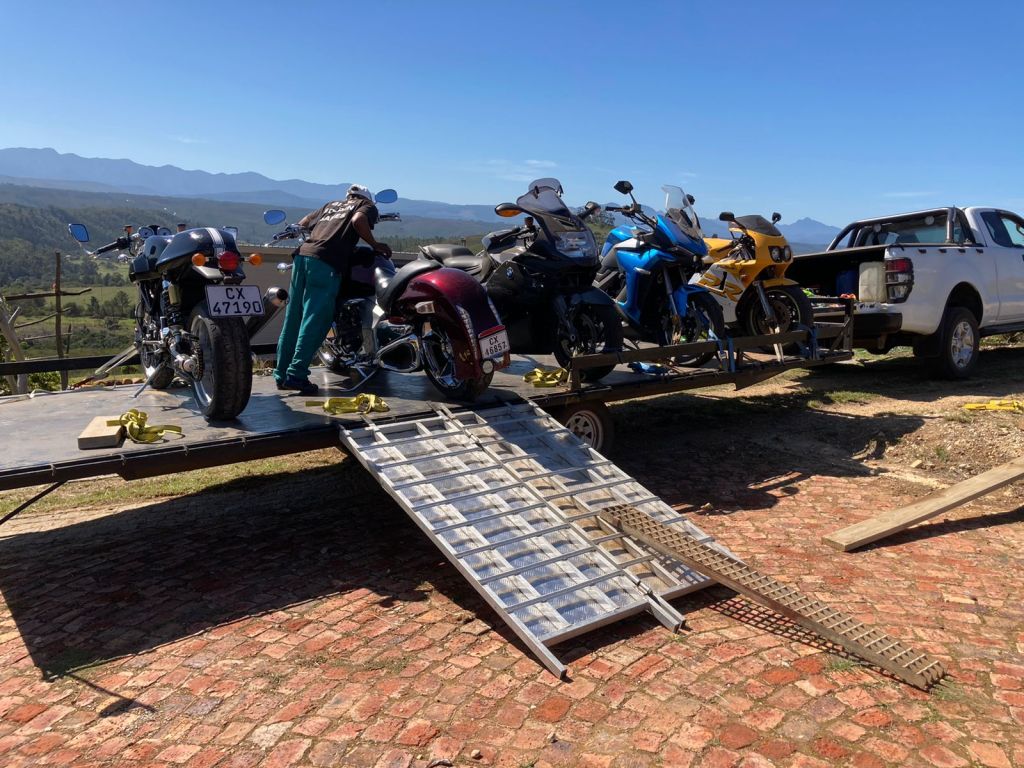
He was towing a 23-foot trailer behind his pick-up truck, already loaded with three other bikes. Our South African house down a steep, 190-metre driveway, and I told him I didn’t rate his chances of turning that ensemble around once down there. Perhaps it might be better to ride each bike up the driveway and load them up on the dirt road? Turned out he reckoned it would be hard to load the bikes on to the trailer up there, so the next I heard he was down by the house and didn’t have the power to reverse uphill to turn the rig around. A call to another neighbour, Aubrey, brought him to the rescue in a more powerful 4×4 pick-up, which did the trick. I breathed a sigh of relief and left them to it – until just now, when Hendrik called via WhatsApp video to say the Rune is too low to load on to the trailer without scaping the underside.

It was good to see both bikes gleaming under the blue skies and bright sunshine, at least, on the video call (gotta love technology). Hendrik’s plan was to bring back Aubrey with few of his guys who would then lift the rear end up in the air to complete the loading. The Rune weights 888 lb, however, and lifting the back might be difficult or might even damage the bike. I’ve remembered that there are a few short pieces of scaffolding plank tucked away in the garage and suggested that they ride the bike on to those to create the ground clearance. That’s how I change the oil, too. So right now that’s what they’re doing. The hail here has stopped and the sun has come out, so things are looking up. Hopefully the Rune is up, too.

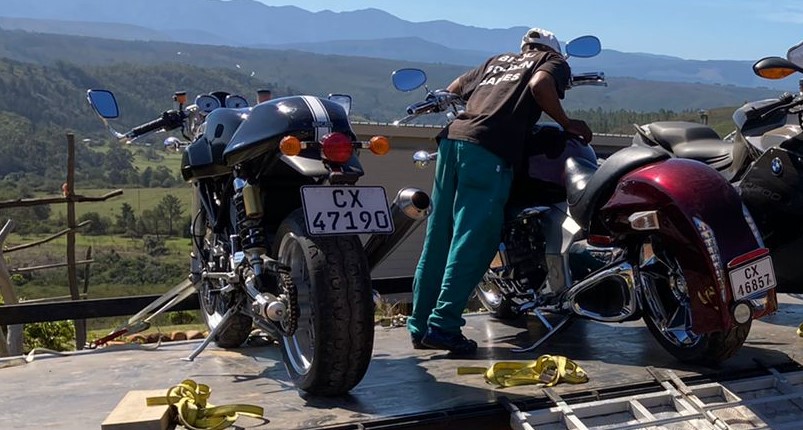
Hendrik just sent me this photo to show me both bikes successfully loaded on to the trailer and about to embark on their five-or-six-hour road trip to Cape Town. Turns out the plank trick didn’t work but muscle power did. Next, it’s a few days to get the micro-dotting and other documentation done, and maybe a week or two more while the shipper waits to fill his container, a mere 16 days on the high seas to London, perhaps a day or two in British Customs, and a final day to Stockport. It’s quite a palaver, but air freight was at least twice the cost – and good things are worth waiting for.

Sweet six carb fix delivers ride with a mile-wide smile

It’s only 3 degrees out there but I’ve just finished a ride with a smile a mile wide. After 13 months of enforced layover, my Valkyrie had sounded out of sorts when I fired it up for the first time. Ran on three cylinders for a bit, then the other three joined in, but it was rough, especially below 2,000 rpm. Something was amiss – and the mile-wide smile is the result of some clever input from a guy called Andy: the Valk now runs like a dream.

My first reaction to the problem was to take the machine out on to a fast stretch of road for a 20-mile blast to blow the cobwebs away. It helped, but not much. My next recourse was to ask advice from the Valkyrie Riders Cruiser Club UK group on Facebook; as ever, members were quick to respond.

The most likely explanation was a build-up of ethanol at the bottom of the tank that had gummed-up some of the jets in the six carburettors. A couple of people recommended a product called Sea Foam, but it would take five days to arrive and I wanted the bike sorted faster and more cheaply than that. Another recommended using 98 octane fuel, which I tried (hard to find, even if you settle for 97); the engine seemed to run better on that, but it wasn’t perfect, didn’t provide a fix, and cost a fortune! A browse through Halford’s presented a few different products offering to clean your carbs, including good old STP; I had no idea it still existed, having proudly put an STP sticker on my helmet 50 years ago. The STP seemed to help, but the bike was still running a bit rough below 2,000 rpm.

The solution came by chance. Son-in-law Nikolas donated a folding bicycle to our son James. It needed both brake cables renewing, so I found a guy called Jason who sorted it all out at a reasonable price. He had a Suzuki 600 Bandit under a cover in his workshop, so we got talking bikes. He mentioned that a mate, Andy, who was an expert with carbs, had re-jetted the bike to suit the aftermarket pipes and it ran like a dream.

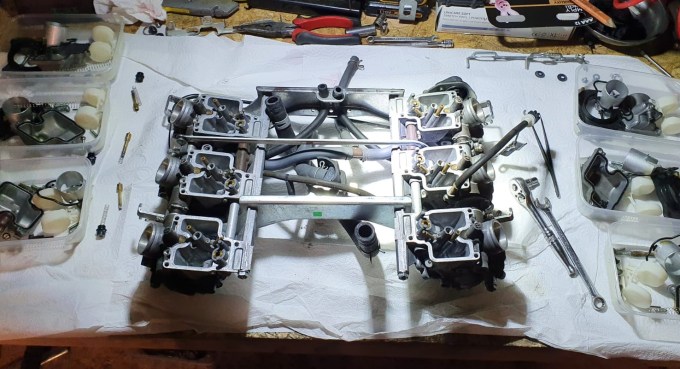
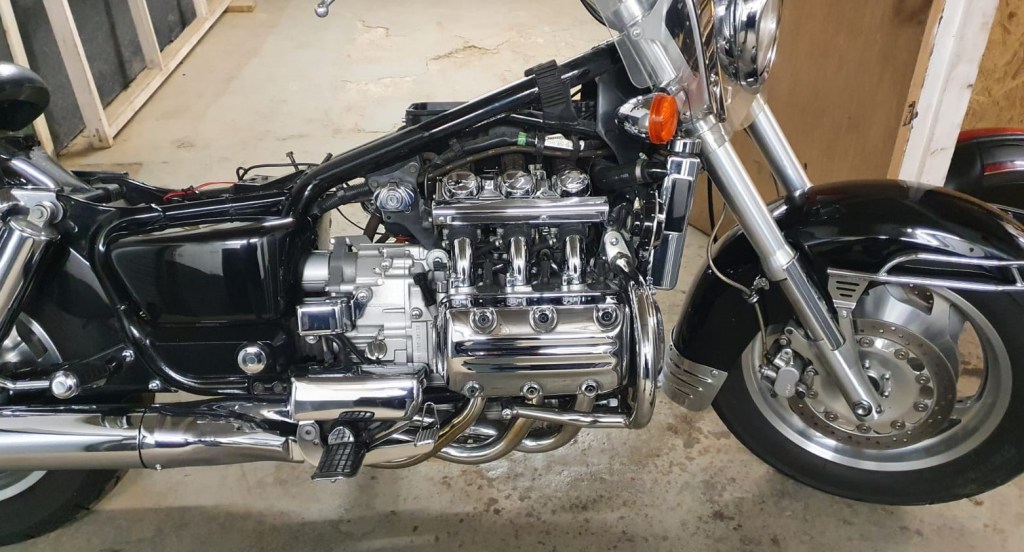
Andy turned out to be a qualified motorcycle mechanic who had never worked on a Valkyrie but was happy to strip, clean and rebuild the six carbs for me. You can see his neat, well-ordered approach in the lead photo. As soon as he had the tank off, he found an incredibly dirty air filter that could have been the main problem all on its own. That in itself was a surprise, because in the seven years I’ve owned the bike I’ve always had it serviced by Honda main dealers to maintain its unbroken full service history since it was new in 2002. I’d have expected the dealers concerned to have replaced the air filter whenever required; I’ll have to check through old paperwork to see whether they did.

The Valkyrie also has a pre-filter, a sponge-like thing that now lay in near-total disintegration over the air filter. Maybe that was causing the poor low-speed running? Or maybe it was the two split vacuum pipes, or the fact that some of the airbox rubbers connecting the carbs were coming away from the airbox? If this were a detective novel, there were already several credible suspects before he’d even got to the jets.

Andy fully stripped the carbs but found no unusual deposits – said he’d seen many worse examples. In any event, he soaked them in carb cleaner overnight and put them back together. He replaced the vacuum tubes and the pipe to the carb heaters, and re-sealed the airbox rubbers. He installed the new air filter (great service from Fowlers, by the way – ordered 18:35 Tuesday, delivered 08:55 Thursday) and made up a new pre-filter from Scotchbrite, which was another helpful tip from the VRCCUK folks on Facebook.

I knew the moment I fired it up that it was much better. Once warmed-up, it was a revelation: the original smooth, sweet-revving flat six was back. No roughness below 2,000 rpm, or anywhere else for that matter – just creamy power. Result! I have no idea which of the various maladies caused the problem, but there is no doubt some combination was responsible. It’s just great to have my old bike back. Now if only the weather would run so sweetly…

Let’s not drive down a blind EV alley

My father once told me that when he was a boy in the 1920s he worried that the world’s oil would run out before he could own a car. Happily it didn’t, and he went on to own and enjoy many cars. I was always more of a motorcycle enthusiast, gaining my first bike licence when I was 16 and seeing no reason to get a car licence till I was 22. I soon saw the advantages of both and, since then, bikes and cars have been a huge part of my life.

So the recent announcement by the British government that sales of all petrol- and diesel-engined cars will cease in 2030 came as a shock. It’s not that it wasn’t expected (it’s been trumpeted for a long time, with only the date changing), but knowing that the ban is now just 10 years off is a serious game-changer. On a practical level, maybe the impact won’t be so great: petrolheads like me can just buy the biggest, baddest petrol-engined car we can find in 2029 and know that it will see out my days. We’ll just have to hope that the network of petrol stations will still be in place.

What I’m having trouble getting my head around are all the other implications. Where to start? All the talk is about cars. Well, what about motorcycles? For now, there are no plans to include bikes in the ICE ban, but who knows what our rulers will decree? What happens to research and development in the ICE sector? Much though the environmentalists fail to acknowledge the fact, car manufacturers have made huge progress in reducing exhaust pollution and cutting fuel consumption, both of which help the environment. With only 10 years of sales potential left, will ICE R&D just stop dead now? That would be unprecedented.

Then there’s the headlong rush toward electric vehicles as the future of transport. On whose advice? Let’s not forget that the Labour government in 2001 prompted the “dash for diesel” because some numpty persuaded the Chancellor that carbon dioxide (CO2) was the enemy. Diesels produce less CO2, so they were judged better for the environment despite their high nitrogen oxide and particulate emissions. So much for experts.

Now we have experts pushing EVs. Why should they be believed? EVs are considerably more expensive than conventional cars; their range is abysmal; it’s doubtful whether the charging network will ever be sufficient; and what happens to those of us who live in flats or houses with no off-street parking? We’ll be forced to rely exclusively on commercial charging stations. A new report just out claims an EV has to cover 48,500 miles before its total CO2 footprint comes down to the level of a petrol-engined car, due to the amount of pollution associated with its manufacture. Hydrogen fuel cells seem to provide a better alternative, although the nay-sayers point to the amount of energy needed to manufacture the hydrogen gas. Let’s see some investment into tackling that issue before we get too far down the traditional EV route. And there’s a Porsche-led consortium busy making a synthetic fuel for ICEs, too.

Then there’s the matter of how much vehicle emissions contribute to global warming. At the time of maximum Covid-19 lockdown, with only 5% of normal car and air traffic, the reduction in air pollution was a mere 17%. Are we about to experience a massive re-engineering of our daily lives, at great expense and enormous inconvenience, just to deliver a 17% cut in air pollution? What will our politicians and their expert advisers say then? Sorry? Not good enough.

A “sustainability journalist” named Tim Smedley has just written an article for The Sunday Times calling for the government to deal with “the killer car” in the wake of a coroner’s finding that the tragic death of a young girl in London was due to air pollution. The sad case involved a girl with chronic asthma living a stone’s throw from the busy South Circular Road. Anyone who knows the area will be aware of the huge number of trucks, vans and buses clogging that artery, but Smedley wants to use the incident to get people out of their cars and make them walk, cycle or take public transport. So he’s laying the blame squarely on cars, and it’s clear that he and many of his ilk are leading a crusade against something they see as elitist. He doesn’t even mention EVs as a possible solution to his problem. In the real world, walking, cycling and buses/trains are not practical ways of completing any of my journeys. Fancy doing a weekly family food shop by bicycle or bus?

So, in a world turned inside out by Covid and Brexit, we are facing a battle against those who (with increasing power) see private transport as inherently bad and have a vision of their own car-less (and probably motorcycle-less) utopia. Let’s hope these loons can be resisted.

Plan D: When a warm bed trumps a soggy campsite

Photo by Kelly Sikkema on Unsplash

If you can’t work with plan A, go to plan B – always a good motto. We’d planned to try out our new tent on the North Coast 500 last year (a route that hugs the Scottish coastline), but illness prevented that. We then planned to use it in France and Italy this summer, but the very late delivery of my driving licence prevented that – and Covid-19 would have made it a bit dodgy, too.

Plan C involved a three-day window of warm and sunny autumn weather in the Lake District. Sunday dawned bright and sunny in Stockport, so for the first time in more than a year we loaded up the Valkyrie with tent, sleeping bags, high-tech air mattresses and as few clothes as we could get away with. We’d pre-booked a campsite in the Lakes. There wasn’t much of a selection to choose from, but it was out of season and maybe Covid had closed the better ones. Compared with the sites we use on the Continent, these looked a bit sparse in the facilities department, with one boasting of a new shower block! We tend to take an on-site bar, restaurant and extensive washrooms for granted, but maybe we’ve just been lucky over the years.

We set off up the M60 and the M62 in warm sunshine, enjoying the feeling of being off on a road trip again, albeit a short one. Traffic was light and stayed that way as we branched off on to A roads, but then it got busy – especially with bikes. We passed probably 100 scooters coming back from a rally somewhere. I’d forgotten how reckless some riders can be on open roads. A reminder came when we slowed to a crawl at the scene of an accident, where the tail of a sports bike was sticking out of a hedge, and not quite at ground level, either.

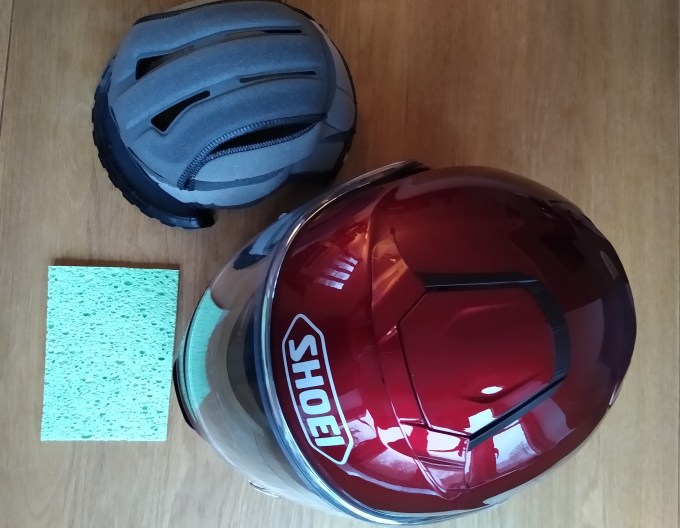
As the road climbed higher, the sky grew cloudier and the air cooler. The clouds looked ominous in the direction we were heading, enveloping the hilltops in the distance. It started to drizzle, and the drizzle changed to rain as the patches of blue receded behind us. The rain became heavier. Peter on the pillion was reporting that her new Shoei Neotec was hurting the top of her head, just as mine had, so I resolved to give her my sponge pad to try. The joy of our new Sena intercom was the ease of discussing whether to abort the trip or not.

We stopped for fuel and a sandwich and watched the weather get wetter and gloomier. The prospect of setting up a new tent in a wet field, sleeping through a wet night and waking up to a wet morning didn’t have huge appeal – not compared with the nice warm bed waiting at home. We’d crossed the M6 motorway only a few miles back, and it seemed to promise a fast route back to sunshine, warmth and maybe dry roads. That’s what we did – it turned out to be Plan D! Some people think nothing of riding and camping in the rain; I’ve done a lot of the former and a bit of the latter and see no pleasure in either, apart from that recent ride home after a year off the road. Happily, the rain stopped within minutes of joining the motorway south, then the clouds parted, and the ride home was sunny and warm; it was like visiting two climates in the space of 30 minutes.

A few days later we headed out for a day trip. I gave Peter my helmet sponge pad and tried my own replacement liner instead. She was much happier with the pad in place. The new liner solved the roof-of-the-head issue for me but instead transferred the pain to my forehead, which was why I’d chosen the larger liner in the first place! Motolegends kindly supplied another skull-cap sponge for me and now we’re both sorted, even if it’s a bit of a Mickey Mouse solution for a top-of-the-range lid. The tent, however, is back in the attic till next spring.

Rain, leaks and a sore head can’t spoil the fun

The rain started to fall less than half-way into the 200-mile trip: so much for believing the weather forecast – after more than 50 years of living in the British Isles you’d think I’d know better! My vision of returning to serious biking in endless sunshine after a year’s break ended in a service area on the M40.

The plan had been to ride from Woking, the bike’s normal garaging place, to Stockport, where we live. On Sunday, the following Wednesday looked dry and warm-ish, according to BBC Weather. By Tuesday night my wife and I were committed to travelling the next day, but whatever had been brewing in the Atlantic for Thursday brewed a little faster and brought heavy rain by midday Wednesday.

The day started well enough. It felt truly wonderful to be back on two wheels after my enforced layoff. The bike had a fresh tank of 97-octane unleaded and was running far more smoothly than the day I’d put it back on the road. My brand new Shoei Neotec 2 helmet was comfortable and quiet at first, but after about 90 minutes it started biting into the top of my head.

The rain started to spit down as I pulled into the service area to have some lunch and don waterproofs. I couldn’t find any obvious reason for the helmet issue so headed off again, planning to ride cross-country towards Derby to pick up the A50 and then the A515 through the Pennines – much more fun on a bike than the dreary M6. My wife, following an hour behind me in the car, discovered the route and always prefers it, too.

We’d treated ourselves to the luxury of built-in Sena headsets after years of grappling with the wires of an Autocom system. However, you need to study the leaflet well to sort out the combination of three buttons and how long you press each one to get radio, phone, intercom or satnav – and my leaflet was in the car with most of our stuff.

My Garmin would ensure I found my way home – I’d only travelled this route as a car passenger and wasn’t entirely familiar with it – but one of the reasons I’d spent a small fortune on two Sena units was to have the audio feed from the sat-nav. I pulled over into a lay-by and fiddled with the buttons: was it centre button for on, then five seconds holding down centre and the + button together for sat-nav? I was rewarded with some encouraging beeps and set off again, with Alexa’s cousin giving me route information.

The rain got heavier, but the pleasant Pennine roads provided plenty of diversion. It just felt so good to be riding again. By the time I reached home, I’d made a few discoveries: my Alpinestars riding boots, which are about 12 years old, were no longer waterproof, despite their Gore-Tex lining; neither was my Rukka jacket, which had kept me warm and dry these past 17 years but was now letting water in around the stomach area; and my new helmet was definitely digging into the crown of my head.

The boots and jacket are probably overdue for replacement, and I’ll do that in due course, but the helmet was a worry. I’d just spent something in excess of £700 on the lid and headset, and what had seemed fine in the showroom was now a disappointment. I get my riding gear mostly from Motolegends in Guildford, and have always found them excellent, so I dashed off an email next morning. Help!

They’d recommended the Shoei over Schuberth, which I’d had for my last two helmets, saying it would better suit my skull shape. I’d opted for a slightly larger lining for greater comfort, but that allows the helmet to sit every so slightly lower on the head. The larger insert also has less padding on top, and that was causing the harder internal centre rib to dig in. They dispatched a replacement liner and a sponge-like skull pad by first-class post. The pad slips between the helmet shell and the inner lining, and it works a treat.

Despite heavy rain, painful helmets and leaking waterproofs, it still felt wonderful to be back in the saddle. All we needed now was a few days of sunshine and maybe we could go camping…

Back on the road to utter joy

It was a Friday in late summer, but it was like all my Christmases had come at once. Right up there behind my wedding, the birth of my children and riding my first CBX. That Friday was the day I got my driving licence back after a year’s break – not for doing anything naughty, I hasten to add, but on doctor’s orders.

It started with a scan that showed my melanoma (a more serious form of skin cancer) had spread internally to a few parts of my body in the form of small “nodes”. One of them showed up in my brain, sadly, and the doctor said no more driving or riding from that moment on. It was just a precaution, in case I had a seizure or something, which happily I never did.

In practical terms, it was no big deal. My wonderful wife became my chauffeur overnight, and getting from A to B was never a problem. But if your main hobby has been riding motorcycles and driving cars, losing your licence is quite a blow. Having independent transport has been part of everyday life since my 16th birthday 50 years ago, and I’ve taken it for granted.

The only important thing was that the doctors zapped the offending node a few weeks later with a targeted 30-minute dose of radiation, and got rid of it completely. A few months later, the even better news was that my course of immunotherapy had got rid of all the cancer, which was an occasion for great joy. But this is not a tale of cancer: it’s a tale of getting a driving licence back after it’s been taken away.

It’s not as easy as you might imagine. The doctor had the power to say “don’t drive”, and that was that: 10 seconds of conversation. Getting back on the road ain’t so easy. It’s not up to the doctor but to the DVLA (for any overseas readers, that’s the UK’s driver licensing agency). My doctor wrote to the DVLA on 19 March this year telling them that in his opinion I was fine to drive again – in time for spring. Yay! Unfortunately, the Covid-19 lockdown happened four days later. It would take five months, two questionnaires and umpteen phone calls to get my licence back. That Friday a few weeks ago I called yet again, and a lovely Welsh accent told me: “I have good news for you, Mr Rae.” Those are the sweetest eight words I’ve heard in a long time. Result!

It was raining, of course, while most of the intervening months had been dry and sunny, and the Valkyrie was way too clean to get dirty. So I got to drive our car for the first time since we’d bought it a year ago, and decided it was jolly nice. By Saturday the roads had dried out and I took the bike to the nearest garage to put air in the tyres and fill the tank. It was like meeting an old friend after a long absence.

It wasn’t all plain sailing. The engine sounded and felt a bit rough, like it was starved of fuel, but the ever-helpful folk on the Valkyrie Riders Cruiser Club group on Facebook suggested several fuel-system-cleaning remedies. One was horribly expensive and would take days to arrive, one was cheaper but would still take days to arrive, so I bought my first-ever bottle of STP (remember STP?) and that improved the carburetion. Still a bit sub-par, but pretty good.

It was all quite a schlep, the licence thing. I don’t question for a moment the need for a doctor to be able to take people off the road in an instant if they pose or might pose a risk to others. But I do question why it should take five and a half months in total for the same doctor’s judgement that it’s safe to drive again to be put into effect. Even a pandemic like Covid-19 shouldn’t mean that the DVLA effectively shuts up shop for three months or more and deals only with “key workers”.

Anyway, the bike is taxed and insured, I’m licensed once more, and days of open road and endless sunshine beckon. Maybe.

Time to re-inject some classic style into design?

Beauty, we’re told, lies in the eye of the beholder. Fair enough, up to a point. This particular beholder knows exactly what makes for a beautiful motorcycle: curves, deep paint, a fair bit of shiny metal, and an unquantifiable magic ingredient that just makes me go “Ahhh!”.

It’s easier to explain by example: the bikes that set my pulse racing include most Norton Commandos (not the Fastback), Bonnevilles, the Triumph T160, 1970s Ducatis, the 2006 SportClassic range, the Honda CBX, Guzzi V7, MV750/1000 four, Kawasaki Z1, Laverda 1000/1200 – there are many others, but you get the picture.

In the opposite corner, marked “what were they thinking?”, sit most adventure bikes, most KTMs, those Transformer-meets-Alien Kawasaki 1000s, the Honda ST1100 and 1300, and now the 2020 Honda Gold Wing. When I saw my first pictures of the latest Wing, I was gobsmacked!

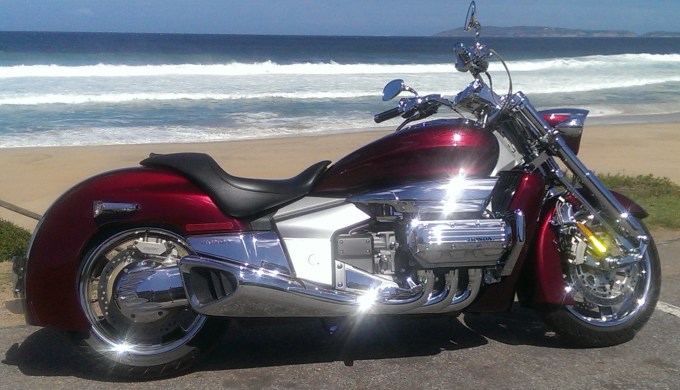
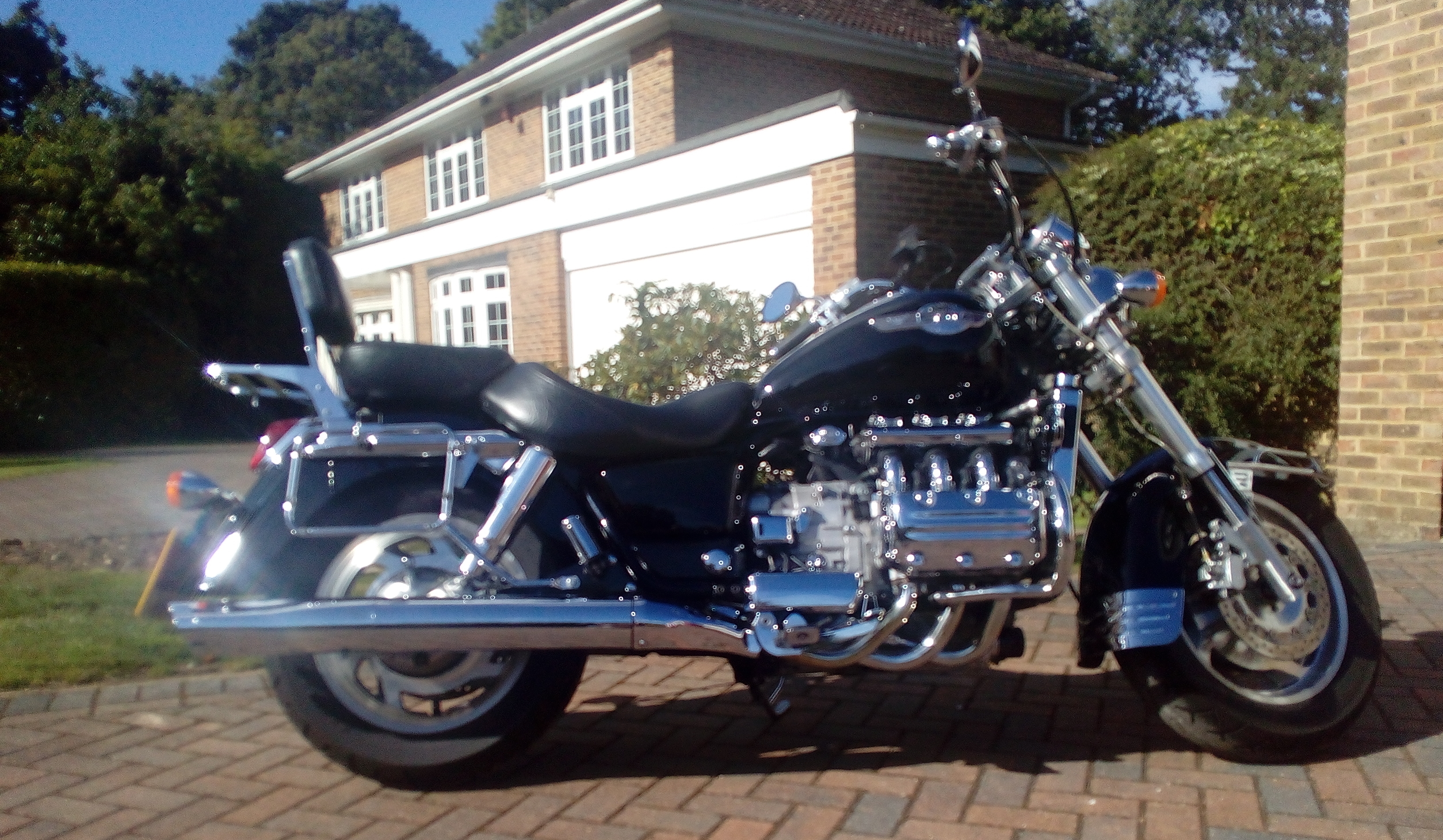
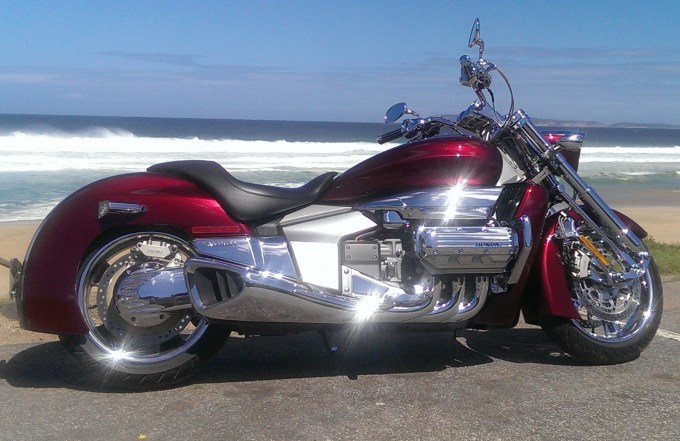
Let me explain some more. I love Gold Wings. I’ve loved them since I first tested one in the late 1970s. I wrote a book about them called, appropriately enough, Gold Wing. I rode a rented 1800 through Colorado with my wife and loved it. I’ve owned three Valkyries, which are essentially naked Wings with some added style, and the marvellous 2004 Valkyrie Rune in the main photo.

There are faster bikes, lighter bikes (and then some!), but the original flat four and latterly flat six engines are peerless. Smooth, turbine-like and utterly delightful. Add in the various creature comforts that have appeared on the Wing over the years and you have a fabulous touring bike, made even better by the frame and suspension that came with the 1800s. This is a bike that handles far better than it should. No doubt tests will reveal that the 2020 Wing is the best ever.

Some say that form should follow function. I accept that too, again up to a point. That’s why I admire the off-road capabilities of KTMs and Super Teneres and their ilk, even though I think they’re ugly. That’s why I can accept the acres of plastic that have adorned Gold Wings for decades, because they provide the weather protection and luggage capacity that you need on a serious tourer.

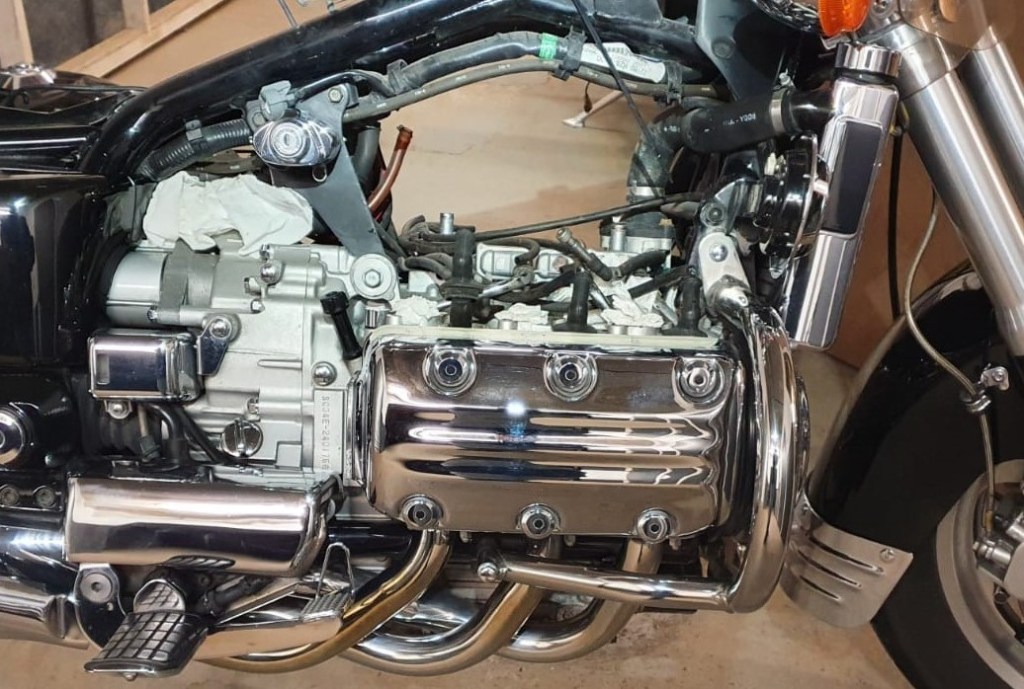
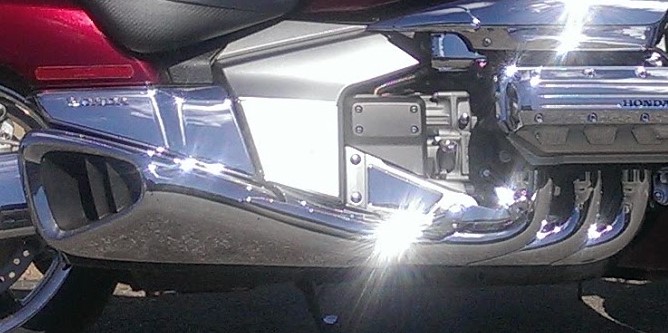
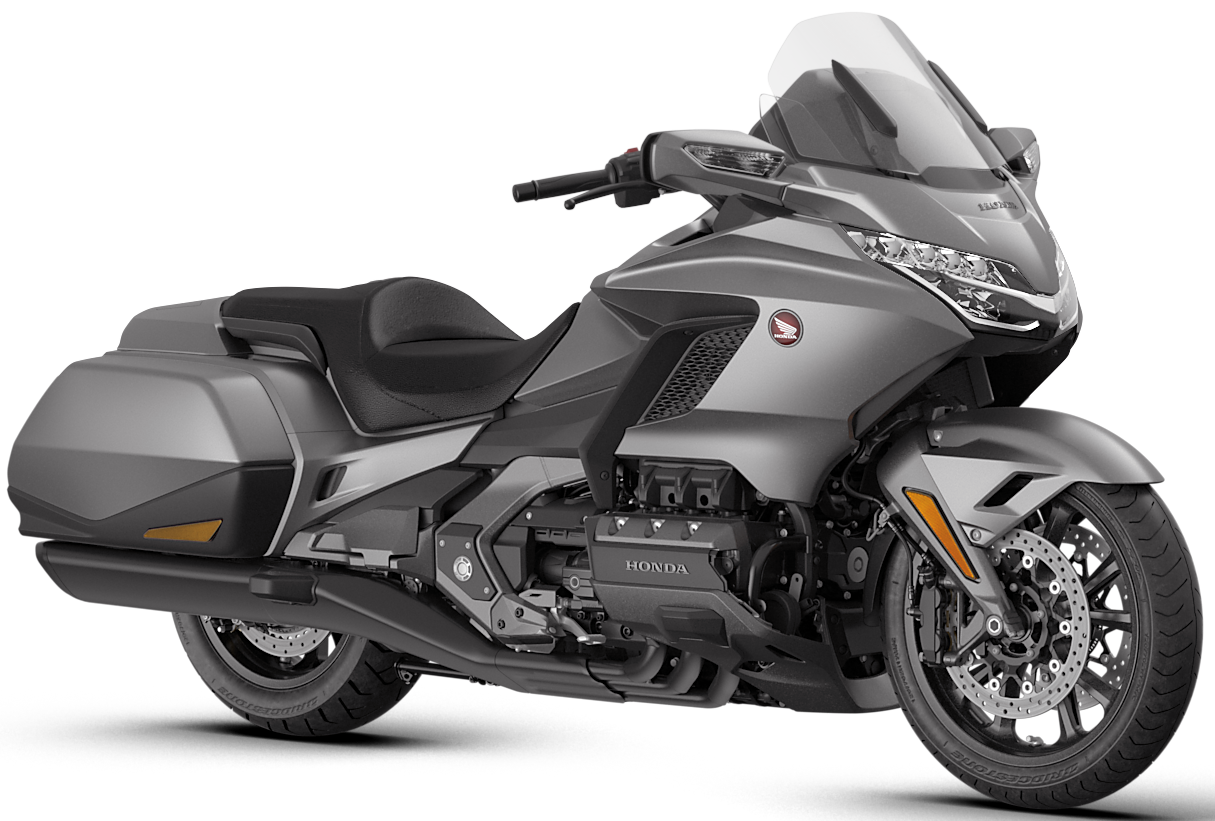
But for crying out loud – look at the engine on the 2020 Wing! The once-beautiful chrome rocker covers have been replaced by what looks from the photos like dull plastic. So too the chrome timing belt cover on the front of the engine – more dull plastic. Compare the 2020 model engine to the Valkyrie’s motor in these photos, or the Rune above, and tell me which looks better.


goldwing__goldwing_gl1800_2019__nh-b70m_matte_majestic_silver_metallic__001 (3)

There’s been so much progress in motorcycle design and technology over the 52 years of my riding career, and modern bikes can run rings around machines from even 20 years ago. But that doesn’t have to be at the expense of art. The new Wing would look so much better if it borrowed a few styling cues from the Rune or the Valkyrie below – and surely it would perform every bit as well?

Valkyrie after repair 1

Happy New Year!

I’m sorry – I didn’t see you!

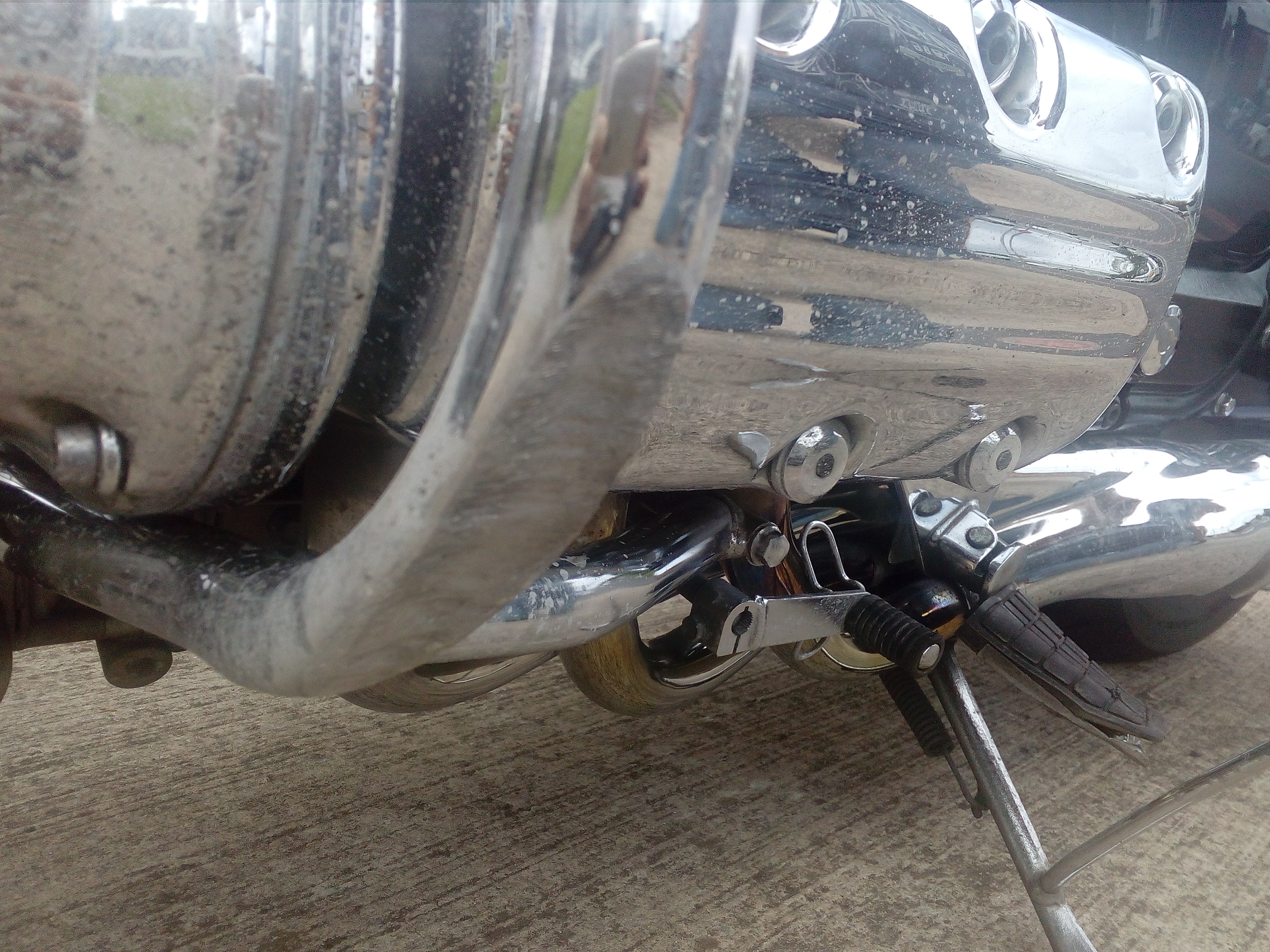
1774410G Damaged engine bar and footrest

I could hear a small car engine revving hard, followed a nanosecond later by a VW appearing in my peripheral vision, and then the sickening crunch as the car slammed into the side of my bike. The young physiotherapist who’d been following behind us later described the incident as “outrageous – I’ve never seen anything like it”.

My wife and I were riding the Valkyrie home along Palatine Road in Manchester at 7 pm on a rainy July evening, and the traffic meant we were doing about 18 mph in the outside of two lanes. We’d just gone past a side road; I reckon the bike was already three quarters past the junction.

The numpty in the VW spotted a gap in the traffic and decided to accelerate hard out of the side road, turn left and join the main road. He was so focused on getting out in front of the next car that he drove straight into the bike. Responding more to senses than anything else, I tried to move as far away from the oncoming bonnet as I could, but he still hit us hard and down we went.

I was vaguely aware of pains in my left knee, ribcage and left elbow, but got up quickly and tended to my wife, who was lying on her back on the wet street. She was hurting on her left arm and left knee but seemed otherwise okay as people started to come to our aid.

I looked over to find the car driver and shouted “What the hell did you think you were doing?” I couldn’t believe what had just happened.

“I’m sorry – I didn’t see you,” came the lame reply. That took me instantly back more than 40 years to a TV programme I made in the ‘70s with some colleagues from the British Motorcyclists’ Federation (BMF). The BBC gave us 15 minutes to air a programme about bikes, and we decided to go with a road safety theme. We called the programme “I’m sorry, I didn’t see you” – what irony!

My wife was in obvious pain but the first three people to attend were the physio, a passing nurse and a passing doctor. An ambulance arrived in record time and the crew tended to Peter’s wounds, which were a gash to her knee and a worse one on her forearm. A couple of guys helped me pick up the Valkyrie and move it to the pavement. It didn’t seem too badly damaged, having sustained mostly left-side scratches and scrapes.

I exchanged insurance with the car driver, who seemed genuinely contrite for what he’d done, no doubt prompted by the sight of Peter still lying on the wet road. He told me a couple of more times that he was sorry but he hadn’t seen us. I wanted to know how he could miss seeing us: huge bike, headlight on, fairly large rider, not six feet away from him. He just sort of shrugged. He didn’t see us because he hadn’t looked.

The good news is that our wounds were suitably dressed after a four-hour visit to A&E, and eventually healed. I had badly bruised ribs, a moderately deep cut on my left arm and a small chip of bone off the apex of my left elbow. We were lucky, really, because we had most of our riding gear on, apart from protective trousers. The helmets were both heavily scratched, showing yet again how important good headgear is, even in a low-speed fall. Peter’s leather jacket had elbow and shoulder armour but somehow she sustained that nasty cut without the jacket sustaining too much damage.

The insurance company (Carole Nash) was great, sending the bike off to 8Ball Custom Paintwork in Ripley, Derbyshire, for some top-notch repairs: the parts that were no longer available (front and rear portions of the silencer) were expertly repaired and re-chromed, and the rest replaced or repaired. The claim of personal injury and riding gear is ongoing.

Valkyrie after repair 1
Looking like new after repairs

A final thought: be sure to keep the receipts for your riding gear. I always have, but still couldn’t find those for my Rukka suit bought 17 years ago. A lot has happened to motorcycle gear in the past 17 years, not least the establishment of certain garments as fashion items. Where once there might have been two or three Rukka jackets, there are now about 25. Try sorting through those to find the closest to a direct replacement for your old jacket!

Helmets can be a problem, too: my trusty Schuberth S2 is no longer made, and nor is my wife’s Shoei GT Air. Try explaining to the lawyers why a £400-odd helmet now costs £600. My heartfelt thanks go out to the folk at Motolegends in Surrey for their help with pricing.

Phoebe, or not to be

Buying a used motorcycle online involves an act of faith. I’ve only done it once, when I bought my Honda Valkyrie Rune sight-unseen over the Internet from a dealer in Cape Town. The bike was exactly as advertised and I’ve been delighted with it ever since.

I had a similar vibe when I decided to buy a 1999 Honda Valkyrie Interstate in Pretoria last week. Valkyries are a rare sight in South Africa, and I wanted this one, so my wife and I flew the 1,100-odd kilometres to Johannesburg and then were driven the remaining 35 minutes to Pretoria by our daughter Nicky.

The trip was beautifully planned. We’d pick up the bike, spend a couple of days getting important stuff done in Jo’burg, then fold up our large tote bag into one of the panniers, drop our clothes and other belongings into the other pannier and the commodious topbox, and head south on Good Friday. We’d even booked a nice-looking B&B in Smithfield to break up the 1,200km return trip.

The bike looked good when we arrived at the dealer, all bright and shiny in its green-and-silvery-white livery. I dropped to the floor and checked out all the stuff that would worry me – this would be my fifth Valk and I knew what to look for. The engine protection bars were scratched and flattened underneath on both sides, suggesting the bike had been dropped at least twice, but no other damage was visible. All else seemed well, and the nicely polished wheels and forks told me that this bike had never seen salt.

Closer inspection of the paintwork, however, showed some scuffs and scratches on the panniers, handlebar fairing and left silencer, where a careless boot had missed its target many times en route to the side-stand. Two of the four chrome rings around the rear lights in the topbox were badly dented. All of this was mildly irritating, because I like my bikes to look like new even if they are 20 years old, but it wasn’t a lot of wear and tear for a 1999 bike and maybe I could live with it for now.

The engine fired up readily and sounded fine, so I headed out for a short road test. The brakes felt a bit spongy on the forecourt, but I rode out on to the street and down to the first traffic light. The light was red, so I braked – or tried to. Nothing much happened of a retarding nature, so I braked harder. The front brake finally brought the bike to a stop, but the rear unit seemed to play no part in the process. Bugger!

The same things happened at the next four traffic lights, so I took it round the block a second time to get a better feel of things. No, this didn’t feel right. Back at the dealership, the proprietor told me the brakes had been checked by his mechanic and that these were heavy bikes and didn’t stop as readily as a sports bike. I ignored the lesson in the finer points of riding large motorcycles and instead asked if I could take the Interstate to the Honda main dealer I’d spotted just up the road.

The salesman said sure, but said they wouldn’t look at it – “trust me”. It was clearly a personal import from the US rather than an “official” Honda South Africa bike and they wouldn’t want to know. I insisted, however, and he made a call and set it up.

The Honda guys were very helpful. Their mechanic took the bike around the block and came back agreeing that the brakes weren’t good. He suggested the problem might be old brake fluid, air in the system, and what looked to him like non-standard (ie non-Honda) brake pads. All of which could be fixed quite easily, for a price.

More worryingly, he said he could hear an unusual noise from the rear wheel area. He couldn’t pin it down but wondered whether it might be coming from the gearbox or the final drive. I thanked him and rode round the block one final time; I couldn’t hear the noise he’d mentioned, but for me the damage was done. Here was a 20-year-old bike with no service history, terrible brakes, too many scratches, two owners since its arrival in South Africa and no sense of how many before that. To cap it all, it had a mystery noise coming from the final drive or the gearbox.

Sometimes you just have to walk away, and that’s what I did. It was very much a bike I wanted, and the chances of finding another were slim, but it was offered as needing “to be seen to be appreciated” and it clearly wasn’t in the sort of condition that phrase implied. I spent several hours online trying to find an alternative large touring bike for sale in the greater Johannesburg area, but there was nothing that remotely appealed. The Internet trawl did bring up something at the other end of the spectrum, however: a 1988 Yamaha XT500 for almost no money just 45 minutes from home, so that’s a project bike to be investigated soon.

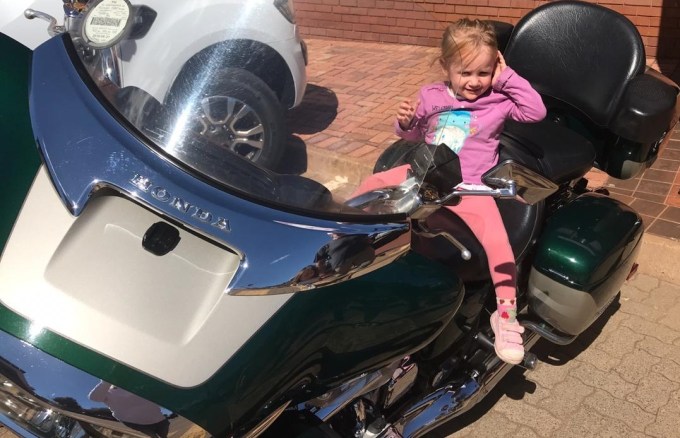
For now, we simply cancelled the much-looked-forward-to road trip, and the pre-booked overnight accommodation, and found two affordable plane tickets back home. The Interstate was not to be. Oh, that’s our two-year-old granddaughter Phoebe in the picture – hence the headline. Unlike the bike, I couldn’t resist it…