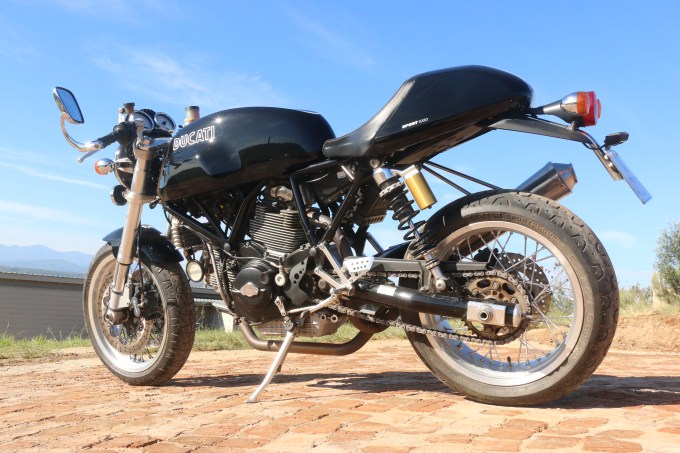
They say that anticipation is the greater part of pleasure. I’ve already written about my long-drawn-out anticipation of the arrival of the Ducati and the Rune in the UK. Would the reality live up to the dream?
I’ve owned the Sport Classic since I bought it new in January 2008, and the Rune since January 2016, so it’s not like we’re strangers. I’ve just spent a small fortune shipping them more than 8,000 miles – so of course they were going to be great to ride again. Even the all-too-short trip to the MOT centre, and the slightly longer trip back again, was an ample reminder of why I like these two very different bikes so much.
The Ducati for me always held the promise of my old 1974 GT750. It was, after all, designed specifically to be a 21st century version of that bike’s 750 Sport sibling, but with all the (many) glitches ironed out. It weighs only 181 kg and puts out about 95 bhp with its Termignoni racing exhaust system. It’s a basic bike – a great engine, two wheels, a seat, a tank and that’s pretty much it – and I see it rather as a latter-day Vincent. It gathers speed in what feels like a very traditional way, giving a visceral push towards the horizon without the exponential feel of a modern four. You either like the glorious feel of a sporty V-twin, or you don’t, and this bike does it for me. I plan to add new Pirelli Phantoms when I get the cambelts replaced soon and it’ll be ready to carve its way through the twisties once more.
Parenthetically, I think it’s nuts in this day and age to design an engine that needs new cambelts every two years, regardless of mileage, at a cost of almost £300 a time including labour and VAT. My old 1997 Suzuki TL1000S, still residing in South Africa in readiness for our next visit, was designed as a Ducati 916-slayer in its day, and it’s never needed that kind of expensive maintenance.
The Rune couldn’t be more different. Take the unburstable (and low-maintenance, by contrast) 1800 Gold Wing engine, tweak it a little, and dress it in one of the funkiest outfits ever to grace a production motorcycle, and you have a unique bike. It weighs 368 kg dry, 398 kg wet, and is fully eight feet long. It has presence. I was reminded of its considerable heft when I had to manoeuvre it into our newly prepared garage, which is approached by a short and slightly downward sloping driveway. Riding it in nose-first was not an option: no way was I ever going to reverse it out again. The trick is to ride it down the drive, turn hard right on to our neighbour’s drive, and perform a four-point turn to reverse it the last few metres into the garage. It takes all the strength in my shoulders and legs to keep the beast upright in those manoeuvres.
Out on the road, it’s wheeled emollient (a phrase I borrow with due credit from Car magazine’s description of the V12 Jaguar Series III XJ6 back in the late ‘80s, and eminently appropriate for both vehicles). The exhaust emits a pleasant burble that becomes a growl on acceleration but never gets raucous. The engine is about as smooth as they come. It develops 118 horsepower at 5500 rpm and 167 Nm of torque at 4000 rpm (or 123 ft lb in old money). That’s enough to move the machine down the road with impressive urgency, with a 12-second standing quarter time, made all the more satisfying by the total absence of vibration. It’s said to be capable of 123 mph or so, but the riding position means it hits a real sweet spot at about 60. That means you can chill out, savour the moment, and overtake pretty much any normal traffic with a flick of the wrist, all safe in the knowledge that you’re not likely to fall foul of speed cameras outside built-up areas. Its slightly outrageous appearance turns heads, for sure, but that’s not why I bought it – it just needs to turn my head, and it does that every time.
Sadly, turning my head is all either bike will be doing for a while yet. My attempts to register them as UK bikes have failed so far. Both applications have been rejected by the DVLA. In the case of the Rune, the issue was lack of proof of year of manufacture; with the Ducati, it was the absence of the original certificate of first registration in South Africa.
This Ducati rejection was a bit galling, because I had sent the original UK registration certificate from 2008 with my application. The same bike had merely travelled to Dubai, Abu Dhabi and South Africa before coming home again. However, the DVLA gave me the option of explaining by letter why I didn’t have the certificate of first registration from South Africa (it’s lying in a filing drawer in our house down there, still inaccessible due to Covid travel rules), so I’ve done that and sent everything back to Swansea. The year of manufacture thing with the Rune was a bit galling too, because the Rune was made only in one year, 2004, although I believe some were made in 2005. If I said it was 2004, that should be good enough, in my book! If it were a 2005 bike, why would I claim it as 2004? The VIN plate on the headstock even proclaims 2004 in large numbers. The DVLA helpfully said they would accept a letter from Honda confirming the year of manufacture. A call to Honda’s UK HQ quickly confirmed that such a letter was indeed possible, for a fee of £30, but it would take up to six weeks. Five weeks later, I’ve just received a note to say the letter is ready and will arrive shortly. Then I can send off all the paperwork to Swansea again. First World problems…
 roadriderblog
Just like the DVLA sluggishness in processing driving licences and testing, you seem to be suffering unduly, but at least the Rune should be sorted soon, just in time for winter! On the Ducati, quite right, the belt changing thing is a pain, so much so that due to my very low mileages, changing the belts every two years when I’d only done say 500 miles, if that, I gave up and took it off the road! A bit extreme, but as it was very much a second bike for a very occasional blast, I really couldn’t come to terms with such expenditure. I’m now at a stage that as I know it’s an appreciating asset, I keep it as one would a painting, something to know you have, something to look at and something you know is not costing you silly money every couple of years!
LikeLike
Hi Jeff! Yes, it’ll be winter by the time I get to use either bike. As long as it’s not raining, I’ll be out there! Interesting solution of yours to the cost of cambelts. I may go that way in two years. I actually tried to sell the Ducati in South Africa before shipping it up here, at quite a high price by local standards. A guy drove all the way from Cape Town (five hours away) in a van to take a look but decided not to buy it. He’d bought an allegedly immaculate Paul Smart replica and to get it up to his standard he stripped all the paint off the engine, bead-blasted it, had the alloy lacquered or something, and rebuilt it. He certainly seemed to know his Ducatis. Mine had less than 3,000 miles on the clock from new and was immaculate too, but he figured he’d still have to do the same. He wanted to keep it in his living room! I thought I was a perfectionist…! We ought to get together now that Covid is less of a problem.
LikeLike